HELLEN KELLER INTERNATIONAL
Nigeria Country Achievements November 2016
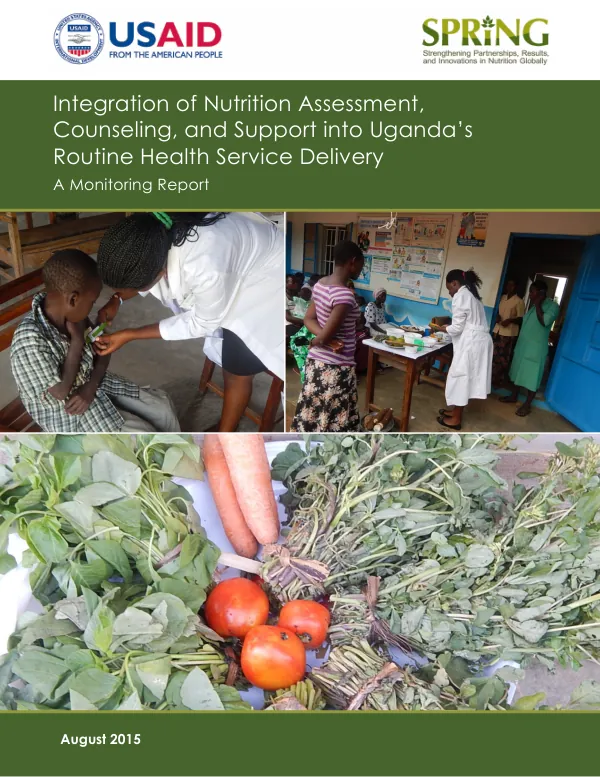
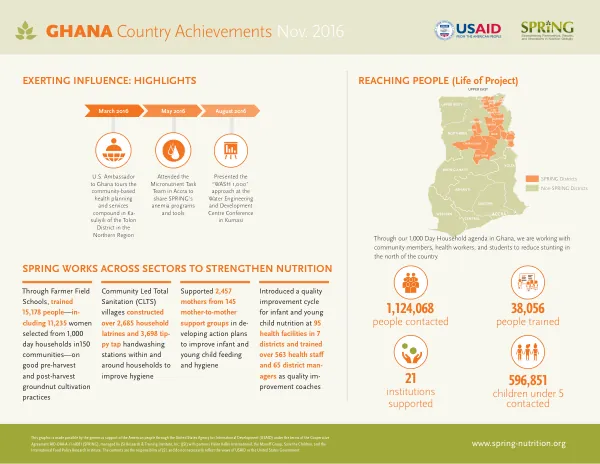
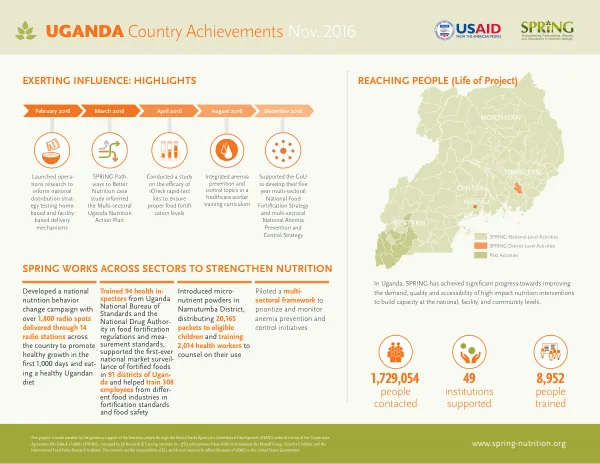
In Uganda, the SPRING project achieved significant progress towards improving the demand, quality, and accessibility of high-impact nutrition interventions to build capacity at the national, facility, and community levels.
2016 · 1 pages
Sign in to readA free account is required to download.
Abstract
The project's pathways to better nutrition case study informed the Multi-sectoral Uganda Nutrition Action Plan. Launched operations research to inform national distribution strategy testing home-based and facility-based delivery mechanisms. Conducted a study on the efficacy of iCheck rapid-test kits to ensure proper food fortification levels. Integrated anemia prevention and control topics in a healthcare worker training curriculum. Supported the Government of Uganda to develop their five-year multi-sectoral National Food Fortification Strategy and multi-sectoral National Anemia Prevention and Control Strategy. Developed a national nutrition behavior change campaign with over 1,800 radio spots delivered through 14 radio stations across the country to promote healthy growth in the first 1,000 days and eating a healthy Ugandan diet. Trained 94 health inspectors from Uganda National Bureau of Standards and the National Drug Authority in food fortification regulations and measurement standards. Supported the first-ever national market surveillance of fortified foods in 91 districts of Uganda and helped train 308 employees from different food industries in fortification standards and food safety. Introduced micronutrient powders in Namutumba District, distributing 20,165 packets to eligible children and training 2,014 health workers to counsel on their use. Piloted a multi-sectoral framework to prioritize and monitor anemia prevention and control initiatives. The SPRING project worked across sectors to strengthen nutrition, contacting 1,729,054 people, training 8,952 people, and supporting 49 institutions. The project's activities spanned multiple sectors, including healthcare, education, and food security, with a focus on improving nutrition outcomes for vulnerable populations.
Related documents