USAID DEC
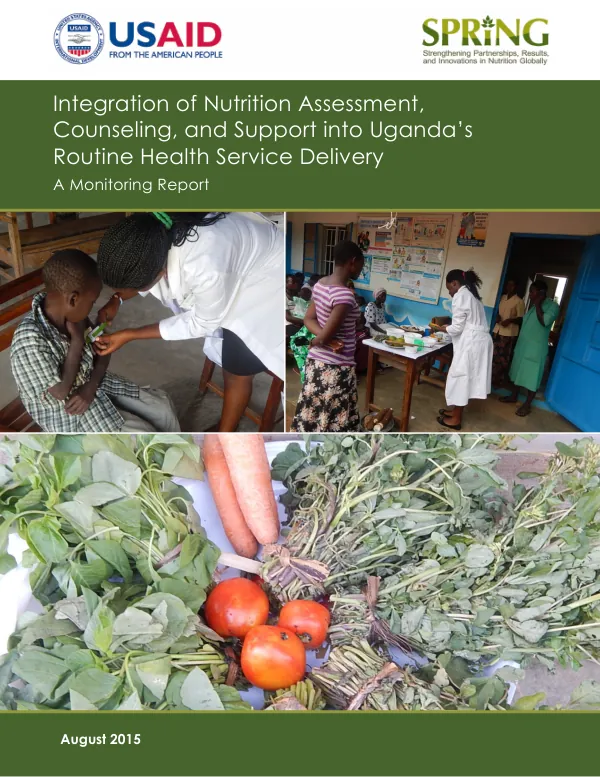
Integration of Nutrition Assessment, Counseling, and Support into Uganda's Routine Health Service Delivery: A Monitoring Report
Sign inHELLEN KELLER INTERNATIONAL
Integration of Nutrition Assessment, Counseling, and Support into Uganda's Routine Health Service Delivery: A Monitoring Report
The integration of nutrition assessment, counseling, and support into Uganda's routine health service delivery is a critical component of the country's efforts to address malnutrition and improve maternal and child health outcomes.
2015 · 58 pages
Sign in to readA free account is required to download.
Abstract
The Strengthening Partnerships, Results, and Innovations in Nutrition Globally (SPRING) project, funded by the United States Agency for International Development (USAID), has been working to strengthen the capacity of health facilities to implement nutrition interventions. Capacity assessments conducted in 2014 revealed that many health facilities in Uganda lacked the necessary infrastructure, equipment, and trained personnel to provide nutrition assessment and counseling services. However, the assessments also identified opportunities for improvement, including the development of guidelines and protocols for nutrition assessment and counseling, as well as the provision of training and support to health workers. The SPRING project has been working to address these gaps through a range of interventions, including the development of a nutrition assessment and counseling protocol, the provision of training and support to health workers, and the establishment of a system for monitoring and evaluating nutrition services. The project has also been working to strengthen the capacity of community health workers to deliver preventive and treatment nutrition services. Key findings from the project's monitoring and evaluation activities include the following: health facilities in Uganda have limited capacity to implement nutrition interventions, with many lacking the necessary infrastructure, equipment, and trained personnel; health workers in Uganda have limited knowledge and skills in nutrition assessment and counseling, with many requiring additional training and support; and community health workers play a critical role in delivering preventive and treatment nutrition services, but require additional support and training to do so effectively. The project's findings also highlight the importance of supportive supervision for health care providers, as well as the need for improved documentation of nutrition data and information. The project has been working to address these gaps through a range of interventions, including the provision of training and support to health workers, the establishment of a system for monitoring and evaluating nutrition services, and the development of guidelines and protocols for nutrition assessment and counseling. Overall, the SPRING project's efforts to integrate nutrition assessment, counseling, and support into Uganda's routine health service delivery have been critical to addressing the country's high rates of malnutrition and improving maternal and child health outcomes. The project's findings and recommendations provide valuable insights for policymakers, program managers, and health care providers seeking to strengthen the capacity of health facilities to provide nutrition services and improve health outcomes in Uganda. The project's monitoring and evaluation activities have also highlighted the importance of community-based health services in delivering preventive and treatment nutrition services. Community health workers play a critical role in delivering these services, but require additional support and training to do so effectively. The project has been working to address these gaps through a range of interventions, including the provision of training and support to community health workers, the establishment of a system for monitoring and evaluating community-based health services, and the development of guidelines and protocols for community-based nutrition services.
Related documents