USAID DEC
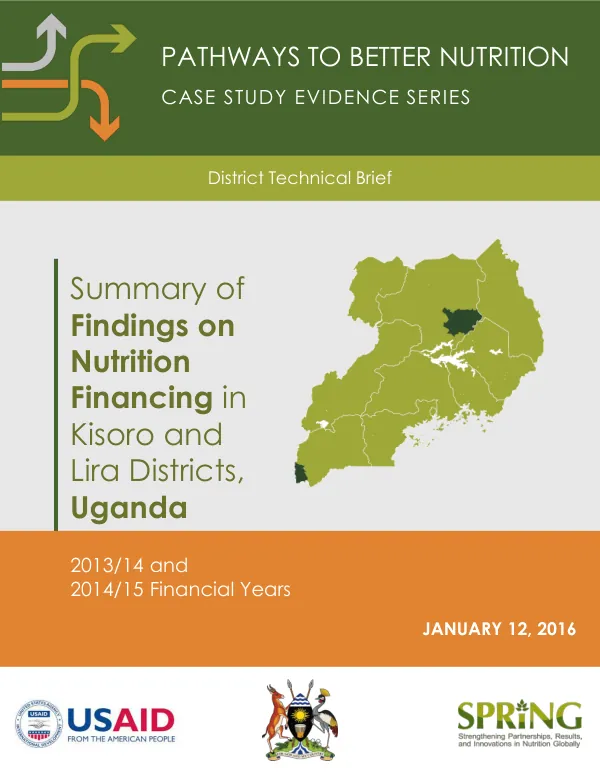
Summary of Findings on Nutrition Financing in Lira and Kisoro Districts, Uganda – 2013/2014 and 2014/15 Financial Years. Pathways to Better Nutrition Case Study Evidence Series. District Technical Brief
Sign inGOVERNMENT OF UGANDA
Summary of Findings on Nutrition Financing in Lira and Kisoro Districts, Uganda – 2013/2014 and 2014/15 Financial Years. Pathways to Better Nutrition Case Study Evidence Series. District Technical Brief
The Government of Uganda (GOU) committed to the Scaling Up Nutrition (SUN) principles in 2011, resulting in the development of the Uganda Nutrition Action Plan (UNAP), 2011-2016.
2015 · 10 pages
Sign in to readA free account is required to download.
Abstract
The plan outlines how the GOU intends to ensure food and nutrition security for all Ugandans, with the ultimate goal of reducing levels of malnutrition among women of reproductive age, infants, and young children. The Pathways to Better Nutrition (PBN) study, led by the USAID-funded Strengthening Partnerships, Results, and Innovations in Nutrition Globally (SPRING) project, explores how the GOU prioritizes nutrition interventions and supports the implementation of the UNAP. Within this larger work, SPRING, in collaboration with Deutsche Stiftung Weltbevoelkerung (DSW), examined whether the GOU and its development partners made the necessary investments to enable the roll-out of UNAP activities in two selected districts – Lira and Kisoro. The study covered two financial years: 2013/14 and 2014/15. The analysis followed the UNAP activity framework for defining nutrition activities and covered the four sectors named in UNAP: education; health; agriculture (or production); and gender, labor, and social development, as well as water. Data were collected from publicly available district budgets, regional referral hospital budgets, and budgets from nongovernmental organizations (NGOs) and development partners (DP) implementing nutrition-related programs. In Lira District, the total budget allocations for nutrition fell from Shs 5.3 billion in 2013/14 to Shs 4 billion in 2014/15. This reduction can be attributed to reductions associated with the suspension of the National Agricultural Advisory Services (NAADS) funding, as well as measurement error due to limited budget information provided by the National Medical Stores (NMS) and by donors for off-budget funding in 2014/15. The analysis revealed that the reduction in nutrition budget allocations in Lira District was largely due to a decrease in funding from the NAADS program. The NAADS program was suspended in 2014/15, resulting in a significant reduction in funding for agriculture-related activities, which are critical for nutrition. The reduction in funding from the NAADS program was not offset by increases in funding from other sources, resulting in a net decrease in nutrition budget allocations. The study also found that the reduction in nutrition budget allocations in Lira District was not limited to the NAADS program. The National Medical Stores (NMS) also provided limited budget information, which contributed to the measurement error. Additionally, donors provided limited information on off-budget funding, which further contributed to the measurement error. In Kisoro District, the total budget allocations for nutrition were not available for analysis. However, the study found that the district had a relatively high level of nutrition-related activities, with a strong presence of NGOs and development partners implementing nutrition-related programs. The study concludes that the reduction in nutrition budget allocations in Lira District highlights the need for increased investment in nutrition-related activities. The study recommends that the GOU and its development partners prioritize nutrition-related activities and provide adequate funding to support the implementation of the UNAP. The study also recommends that the GOU and its development partners strengthen their capacity to track and monitor nutrition-related budget allocations to ensure that adequate funding is provided to support the implementation of the UNAP.
Related documents