USAID DEC
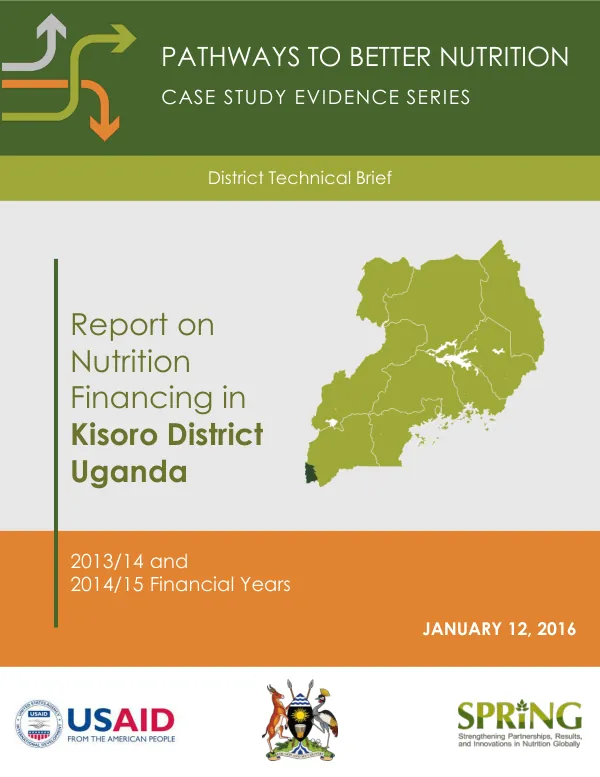
District Technical Brief: Report on Nutrition Financing in Kisoro District– 2013/2014 and 2014/15 Financial Years
Sign inHELLEN KELLER INTERNATIONAL
District Technical Brief: Report on Nutrition Financing in Kisoro District– 2013/2014 and 2014/15 Financial Years
The Ugandan Nutrition Action Plan (UNAP) was developed in 2011 as a commitment to the Scaling Up Nutrition (SUN) Movement.
2016 · 34 pages
Sign in to readA free account is required to download.
Abstract
The plan outlines the Government of Uganda's (GoU) dedication to ensuring food and nutrition security for all Ugandans, particularly those living in areas with high levels of malnutrition. The ultimate goal of the UNAP is to reduce levels of malnutrition among women of reproductive age, infants, and young children by 2016. The UNAP has five strategic objectives, which will be pursued through 2016. These objectives include improving access to and utilization of services related to maternal, infant, and young child nutrition. The plan also has 13 strategic areas, which are outlined in Table 1.1. The UNAP is coordinated by the Office of the Prime Minister (OPM) and aims to ensure that all Ugandans are properly nourished, enabling them to live healthy and productive lives. The Pathways to Better Nutrition Case Study Evidence Series is a report on nutrition financing in Kisoro District, Uganda, for the 2013/2014 and 2014/2015 financial years. The report is part of the SPRING project, a five-year USAID-funded Cooperative Agreement to strengthen global and country efforts to scale up high-impact nutrition practices and policies. The report focuses on the overall budget and nutrition budget allocations in Kisoro District. The findings indicate that the overall budget for Kisoro District was UGX 43.4 billion in 2013/2014 and UGX 45.8 billion in 2014/2015. The nutrition budget allocations were UGX 1.4 billion in 2013/2014 and UGX 1.6 billion in 2014/2015. The report also highlights the challenges faced by Kisoro District in terms of nutrition financing. These challenges include limited budget allocations for nutrition, inadequate funding for nutrition programs, and lack of coordination among stakeholders. The report recommends increasing budget allocations for nutrition, improving coordination among stakeholders, and strengthening the capacity of district officials to manage nutrition programs. The report concludes that the UNAP has made significant progress in improving nutrition outcomes in Uganda. However, there is still a need to strengthen the capacity of district officials to manage nutrition programs, improve coordination among stakeholders, and increase budget allocations for nutrition. The report provides recommendations for improving nutrition financing in Kisoro District and enhancing the effectiveness of the UNAP. The report highlights the importance of nutrition financing in achieving the goals of the UNAP. It emphasizes the need for increased budget allocations for nutrition, improved coordination among stakeholders, and strengthened capacity of district officials to manage nutrition programs. The report provides a comprehensive analysis of the challenges faced by Kisoro District in terms of nutrition financing and offers recommendations for improving nutrition outcomes in the district. The report also highlights the role of the SPRING project in supporting the implementation of the UNAP. The project has provided technical assistance to the Government of Uganda to strengthen its capacity to implement the UNAP. The project has also supported the development of a nutrition budget analysis tool, which has been used to analyze the nutrition budget allocations in Kisoro District.
Related documents
Documents in this collection
 2015
2015USAID DEC
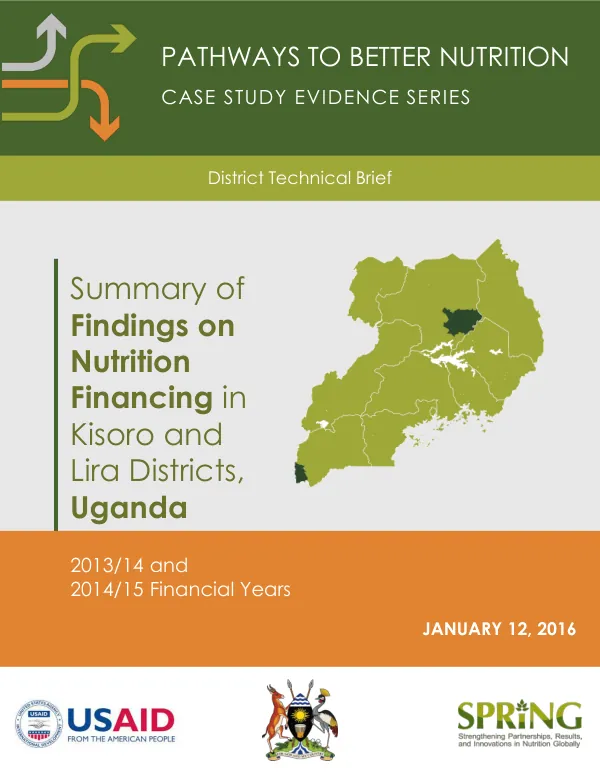
Summary of Findings on Nutrition Financing in Lira and Kisoro Districts, Uganda – 2013/2014 and 2014/15 Financial Years. Pathways to Better Nutrition Case Study Evidence Series. District Technical Brief
Open record 2015
2015USAID DEC