ROBERT NATHAN ASSOCIATES
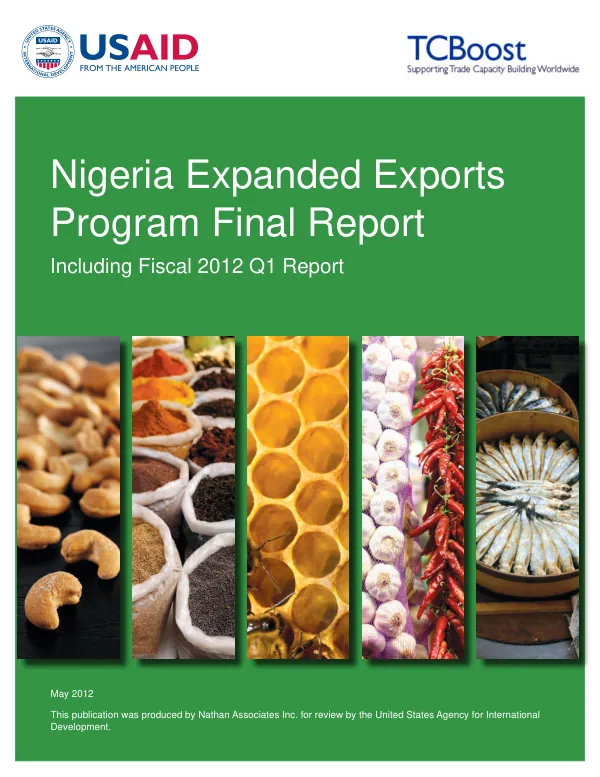
Nigeria Expanded Exports Program Final Report Including Fiscal 2012 Q1 Report
Nigeria's non-oil sector has significant potential for growth and diversification, which can improve the livelihoods of its people.
2012 · 89 pages
Sign in to readA free account is required to download.
Abstract
Increasing productivity and export capacity can be achieved through preferential trade schemes such as the African Growth and Opportunity Act (AGOA) and the ECOWAS Trade Liberalization Scheme (ETLS). However, small- and medium-sized enterprises (SMEs) need assistance in marketing and refining their products for export markets, complying with regulatory requirements, and obtaining financing to expand their businesses. The Nigeria Expanded Exports Program (NEEP) was designed to address these challenges. Launched in 2010, NEEP was a two-year, two million dollar pilot program funded by the United States Agency for International Development (USAID) to help increase non-oil sector exports. The program was tailored to Nigerian needs and leveraged relationships with the USAID West Africa Trade Hub, the Nigerian Export Promotion Council (NEPC), and Nigerian business service providers (BSPs) to maximize resources and position the program for success. NEEP's technical approach focused on providing one-on-one firm-level assistance and group trainings, as well as support for accessing U.S. and regional export markets. The program also addressed access to finance and other focused technical support. NEEP's implementation began in January 2010, with technical and managerial leadership provided remotely by U.S.-based Project Director Michael Blakeley. The project's tight budget and timeline precluded TCBoost from fielding a long-term resident expatriate to run the program. NEEP's client firms received assistance in accessing export-related financing, with over $415,000 in financing facilitated and pending finance requests valued at over $849,078. The program also contributed to a reported export increase of 87% by client firms, from $39.3 million in 2009 to $75.9 million in 2010. NEEP sponsored and conducted 24 training events on key export-related issues, fostered the establishment of the Exporter Cooperative Network (ECN), and maintained momentum on key trade facilitation initiatives. The program's activities and accomplishments are summarized in the following sections. NEEP's design and launch are revisited, including the recruitment and selection of client firms. The program's assistance devoted to specific export markets, as well as export-related assistance of a cross-cutting or universal nature, are also summarized. Lastly, recommendations for future USAID-funded export promotion programs are presented. NEEP's implementation was based in Lagos, with concerted efforts made to attract client firms from throughout the country. Trainings were held in Lagos, Abuja, and Kano, and specific efforts were made to assist potential exporters in the USAID priority states of Sokoto and Bauchi. NEEP also made concerted efforts to reach out to female exporters in Nigeria, cosponsoring events with NEPC and others that emphasized specific opportunities for women entrepreneurs. The program's results are presented in the final quarterly report, which is provided in Appendix A. The final NEEP Monitoring and Evaluation (M&E) matrix is presented along with supplemental information in Appendixes B and C, providing an overview of program results according to key project indicators.
Related documents