USAID DEC
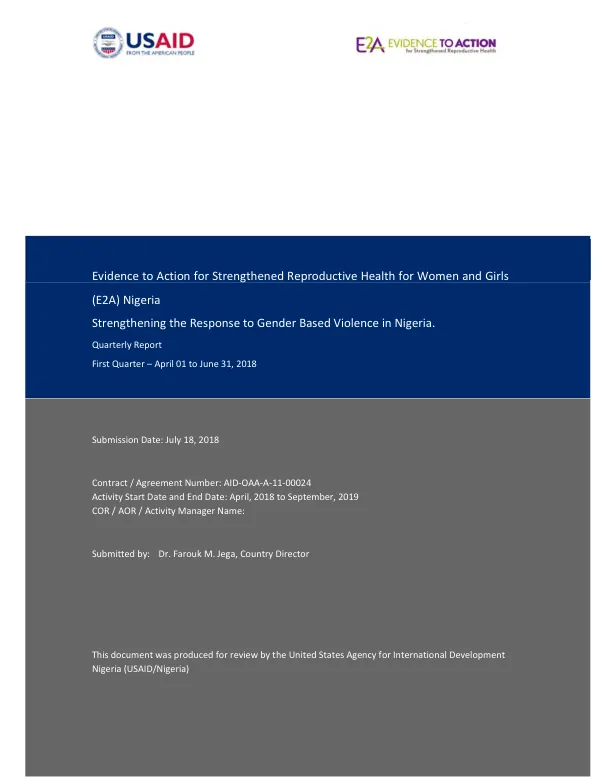
Evidence to Action for Strengthened Reproductive Health for Women and Girls (E2A) Nigeria: Strengthening the Response to Gender Based Violence in Nigeria
Sign inPATHFINDER INTERNATIONAL
Evidence to Action for Strengthened Reproductive Health for Women and Girls (E2A) Nigeria: Strengthening the Response to Gender Based Violence in Nigeria
The Strengthening the Response to Gender Based Violence in Nigeria project, implemented by Pathfinder International, aims to strengthen the response to GBV by building the capacity of sub-grantee Sexual Assault Referral Centers (SARCs) to provide essential health services to GBV survivors.
2018 · 24 pages
Sign in to readA free account is required to download.
Abstract
The project also seeks to improve the collection, analysis, and use of data to better understand GBV in Nigeria and guide future prevention and response programming. The project's overarching objective is to strengthen the capacity of SARCs to provide essential health services to GBV survivors, solicit, manage, and administer additional funds, and contribute to organizational sustainability after USAID support ends. The project's three objectives are to support and strengthen the capacity of SARCs to provide essential health services to GBV survivors, strengthen the capacity of SARCs to solicit, manage, and administer additional funds, and improve the collection, analysis, and use of data to better understand GBV in Nigeria. During the quarter, a total of 410 clients visited the SARCs, with 85% of them being female and 15% being male. Seventy percent of the cases reported were rape cases, 24% were other sexual assault, and 16% reported physical violence. The age group 0-9 years was found to be more vulnerable across the states, with Niger State having the highest number of cases in this age group. The relationship between the client and the perpetrator was also analyzed, with the perpetrators categorized into four groups: Sexual Partner (13%), Family members (14%), Other friends and associates (45%), and Strangers (28%). The low percentage of clients who received post-exposure prophylaxis (PEP) and emergency contraception (EC) was attributed to the late reporting of cases to the SARCs and the non-availability of the commodities on-site. The Pathfinder team supported the SARCs to source EC and PEP in their respective states and make these commodities readily available in the center. These drugs have now been sourced and are available in all the centers except Akwa Ibom, where EC is not available state-wide. Continuous sensitization programs are being implemented to address the issue of late presentation of rape cases to the SARCs. GBV service delivery training was conducted at the Corinthia Hotel, Abuja from July 9-12, 2018, with 20 participants (15 female, 5 male) in attendance. The training aimed to build the capacity of service providers to describe and follow the clinical pathway to ensure that key elements of care are provided to every GBV survivor that visits the SARC. The training also covered how to correctly fill out the medical exam form, use information from the patient's medical history to guide the examination, collect forensic evidence, and write an effective police report. The project has made significant progress in building the capacity of SARCs to provide essential health services to GBV survivors. The training of service providers has improved the quality of care provided to GBV survivors, and the sourcing of EC and PEP has increased the availability of these commodities in the centers. However, there is still a need to address the issue of late presentation of rape cases to the SARCs through continuous sensitization programs. The project's geographic coverage includes Akwa Ibom, Enugu, Jigawa, Kaduna, Kano, Lagos, and Niger states. The project's reporting period is from July 1 to September 30, 2018, and the submission date is October 31, 2018. The project's contract/agreement number is AID-OAA-A-11-00024, and the activity start date and end date are April 2018 to September 2019.
Related documents
Documents in this collection
 2019
2019USAID DEC
Evidence to Action for Strengthened Reproductive Health for Women and Girls (E2A) Nigeria Quarterly Report January 1 to March 31, 2019
Open record 2018
2018USAID DEC