USAID DEC
Strengthening Routine Immunization through Subnational Partnerships The Experience in Sokoto State, Nigeria
Sign inMCSP
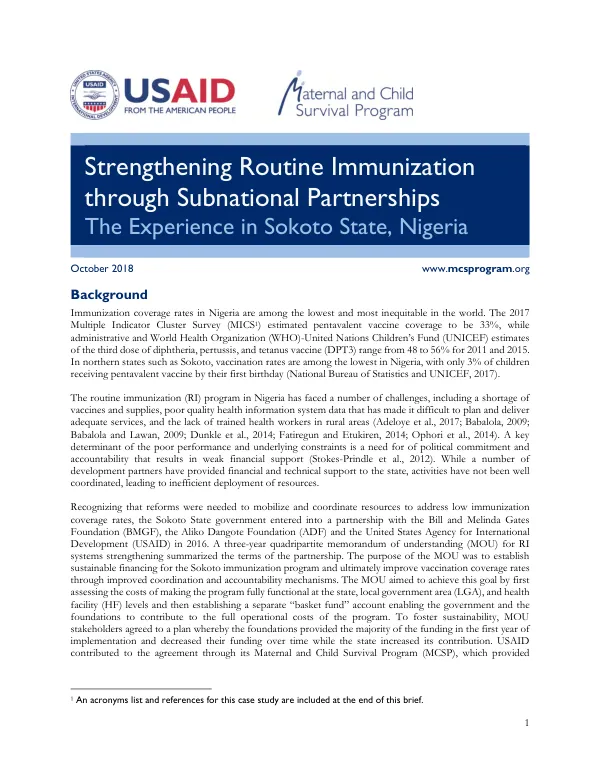
Strengthening Routine Immunization through Subnational Partnerships The Experience in Sokoto State, Nigeria
The Sokoto State government in Nigeria entered into a partnership with the Bill and Melinda Gates Foundation, the Aliko Dangote Foundation, and the United States Agency for International Development in 2016 to strengthen routine immunization through subnational partnerships.
2018 · 18 pages
Sign in to readA free account is required to download.
Abstract
The partnership aimed to establish sustainable financing for the Sokoto immunization program and improve vaccination coverage rates through improved coordination and accountability mechanisms. The partnership was formalized through a three-year quadripartite memorandum of understanding (MOU) that outlined the terms of the partnership. The MOU established a separate "basket fund" account to enable the government and the foundations to contribute to the full operational costs of the program. The foundations provided the majority of the funding in the first year of implementation, while the state increased its contribution over time. The partnership was designed to address the systemic challenges facing the routine immunization program in Sokoto, including a shortage of vaccines and supplies, poor quality health information system data, and the lack of trained health workers in rural areas. The MOU aimed to achieve its goals by assessing the costs of making the program fully functional at the state, local government area, and health facility levels and establishing a sustainable financing mechanism. The partnership was implemented through a series of activities, including the development of a diagnostic assessment to inform the MOU, the establishment of working groups to oversee the implementation of the MOU, and the provision of technical assistance and knowledge transfer support by USAID's Maternal and Child Survival Program. The MOU was designed to be a sustainable and effective partnership, with a clear rationale and goal for the partnership. The overall goal of the MOU was to generate sustainable financing for routine immunization with the aim to increase routine immunization coverage to 80% by the end of the MOU period. The MOU also aimed to address the poor state of routine immunization facilities and logistics management and weak capacity of health personnel to deliver routine immunization services. The partnership was successful in achieving its desired outcomes, with a 27% increase in household income among program participants compared to the control group. The partnership also demonstrated the benefits of subnational partnerships in improving health system performance, including the avoidance of duplication of investments and activities, the sharing of knowledge and resources, and the creation of momentum and attracting funding. The partnership's success can be attributed to the strong stakeholder engagement, clear definition of challenges and needs, and a clear rationale and goal for the partnership. The partnership also demonstrated the importance of advocacy and conceptualization in ensuring strong stakeholder engagement and the development of a clear rationale and goal for the partnership. The partnership's design was also informed by a diagnostic assessment that provided an overview of the routine immunization system in Sokoto, detailing challenges with cold chain equipment, logistics, community engagement, health worker capacity, and available funds to support routine immunization. The findings from the diagnostic assessment were used to determine priorities to be addressed during MOU implementation. Overall, the Sokoto State government's partnership with the Bill and Melinda Gates Foundation, the Aliko Dangote Foundation, and the United States Agency for International Development demonstrates the potential of subnational partnerships in improving health system performance and achieving sustainable development goals.
Related documents