USAID DEC
Nigeria Investment Brief
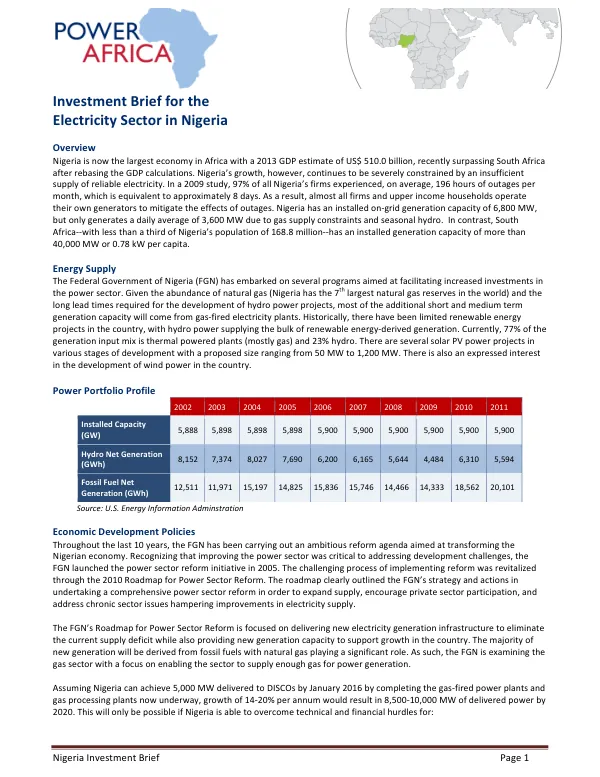
Nigeria is now the largest economy in Africa with a 2013 GDP estimate of US$ 510.0 billion, recently surpassing South Africa after rebasing the GDP calculations.
2015 · 5 pages
Sign in to readA free account is required to download.
Abstract
However, Nigeria's growth continues to be severely constrained by an insufficient supply of reliable electricity. In a 2009 study, 97% of all Nigeria's firms experienced, on average, 196 hours of outages per month, which is equivalent to approximately 8 days. As a result, almost all firms and upper income households operate their own generators to mitigate the effects of outages. Nigeria has an installed on-grid generation capacity of 6,800 MW, but only generates a daily average of 3,600 MW due to gas supply constraints and seasonal hydro. In contrast, South Africa, with less than a third of Nigeria's population of 168.8 million, has an installed generation capacity of more than 40,000 MW or 0.78 kW per capita. The Federal Government of Nigeria (FGN) has embarked on several programs aimed at facilitating increased investments in the power sector. Given the abundance of natural gas (Nigeria has the 7th largest natural gas reserves in the world) and the long lead times required for the development of hydro power projects, most of the additional short and medium term generation capacity will come from gas-fired electricity plants. The FGN's Roadmap for Power Sector Reform is focused on delivering new electricity generation infrastructure to eliminate the current supply deficit while also providing new generation capacity to support growth in the country. The majority of new generation will be derived from fossil fuels, with natural gas playing a significant role. As such, the FGN is examining the gas sector with a focus on enabling the sector to supply enough gas for power generation. Assuming Nigeria can achieve 5,000 MW delivered to DISCOs by January 2016 by completing the gas-fired power plants and gas processing plants now underway, growth of 14-20% per annum would result in 8,500-10,000 MW of delivered power by 2020. This will only be possible if Nigeria is able to overcome technical and financial hurdles for gas pipeline vandalization, gas processing capacity, transmission wheeling capacity, distribution system capacity, installed generation capacity, and gas pipeline capacity. Nigeria has become a top destination of Foreign Direct Investment (FDI) in Africa, across various sectors of the economy, excluding the power sector, thus surpassing South Africa in 2009. The FGN's Transformation Agenda recognized private sector development as the main engine for development and has included bold economic reforms. Investment incentives, particularly targeted for the energy sector, include a tax holiday of 3-5 years granted to companies that manufacture transformers, meters, control panels, switchgears, cable, and other electrical related equipment, which are considered pioneer products/industries. Power plants using gas are assessed under the company Income Tax Act at a reduced rate of 30%. Nigeria is developing a market-based economy, where the role of the FGN is to act as regulator of competitive markets rather than to act as a participant in those markets. Nigeria is open to both private sector investments from local sources as well as from foreign sources of capital, and has developed a number of policies aimed at attracting foreign capital. FDI into Nigeria has significantly increased in the last 10 years as companies respond to incentives by investing in Nigeria's privatized industries and infrastructure. The FGN is looking to the private sector to deliver a substantial portion of required electricity infrastructure investments. While estimates vary, more than US$ 10.0 billion is required to resuscitate and rehabilitate Nigeria's power infrastructure in the next few years.