USAID DEC
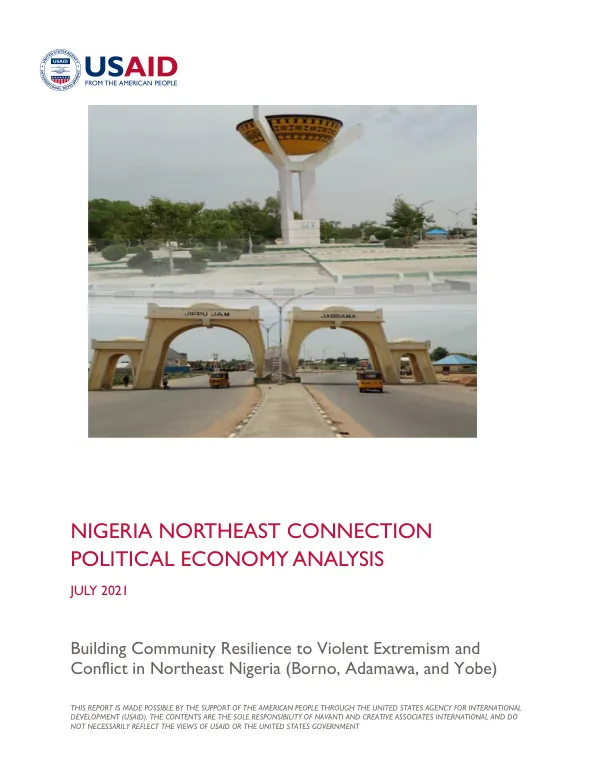
Nigeria Northeast Connection: Building Community Resilience to Violent Extremism and Conflict in Northeast Nigeria
Sign inCREATIVE ASSOCIATES INTERNATIONAL INC.
Nigeria Northeast Connection: Building Community Resilience to Violent Extremism and Conflict in Northeast Nigeria
The Nigeria Northeast Connection Activity aims to strengthen community resilience to violent extremist infiltration and conflict in Adamawa, Borno, and Yobe states in northeast Nigeria.
2021 · 40 pages
Sign in to readA free account is required to download.
Abstract
The program, launched on January 3, 2021, targets communities not yet under the control of violent extremist organizations (VEOs) to mitigate grievances that make communities vulnerable to violent extremism. By building social cohesion within and across communities, the program seeks to address unresolved grievances, governance weaknesses, social divisions, marginalization, and environmental shocks. The program focuses on two complementary components: conflict mitigation, social cohesion, and countering violent extremism (CVE) programming, and conflict and violent extremism research, analysis, and coordination. To achieve the first objective of enhanced community resilience to VE infiltration and conflict, the Activity will facilitate partnerships between diverse local actors, enhancing inter- and intra-community networks. Interventions will identify and implement at the ward level within each target local government area (LGA). The program will work in 15 local government areas (LGAs) throughout Adamawa, Borno, and Yobe states in northeast Nigeria over the life of the project. LGAs were selected based on their accessibility, existing or previous investments, communities' willingness to engage, as well as those that met program objectives. In addition, populations in these LGAs experience ethnic intolerance, community tensions, systemic discrimination, political exclusion, shrinking civic space, limited opportunities for civic participation, economic exclusion of vulnerable groups, and environmental shocks impacting communities' livelihoods. During the second quarter of the program (FY21 Q3), the team continued to make significant progress establishing finance, security, procurement, and communications processes and procedures. The program's senior leadership team coordinated numerous meetings with key stakeholders throughout the BAY states to introduce the program to potential counterparts and partners and facilitate productive relationship building. Meetings focused on ensuring clear understanding of program objectives, highlighting shifts in technical or geographic focus from USAID's previous NRTI and NLCB programs, presenting opportunities for future engagement, and securing support and buy-in to enable NE Connection access to critical offices and communities. The COP and program managers met with approximately 12 local agencies and government bodies at the state level and within the program's target LGAs in Borno and Adamawa. Existing relationships with Creative staff and knowledge of USAID's impactful work in the Northeast aided the team in quickly establishing this series of high-level meetings and open dialogue. The program's objectives and focus were well received by host government actors, and most were keen to learn about the program, share local situation reports, committed to support, and sought fresh working relationships. The program's dedication to a successful startup during its first and second quarter will ensure implementation throughout the remainder of the program is seamless and results in high-quality, impactful activities. The program's focus on building partnerships between diverse local actors, enhancing inter- and intra-community networks, and developing local capacities to identify and respond to emerging threats will contribute to enhanced community resilience to VE infiltration and conflict in northeast Nigeria.
Related documents