DELOITTE CONSULTING, LLP
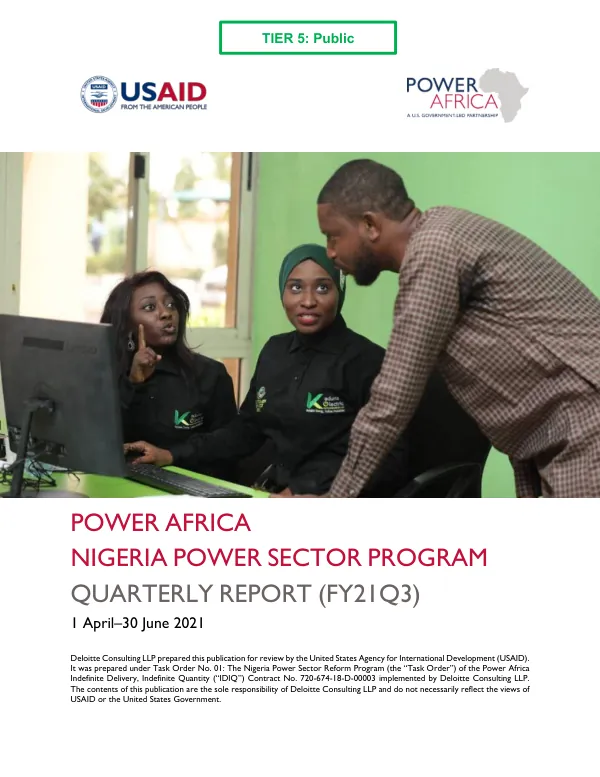
Nigeria Power Sector Program Quarterly Report (FY21Q3)
The Nigeria Power Sector Program, a component of the Power Africa initiative, is a comprehensive effort to address the country's energy challenges.
2021 · 76 pages
Sign in to readA free account is required to download.
Abstract
The program, implemented by Deloitte Consulting LLP, aims to increase access to electricity and promote economic growth. The program's scope encompasses four key outcomes: Energy Resources, On-Grid Generation, Off-Grid, and Enabling Environment. The Energy Resources outcome focuses on increasing the availability of gas supply, with a target of 1.5 billion standard cubic feet per day by the end of the program. To achieve this goal, the program has established partnerships with key stakeholders, including the Nigerian National Petroleum Corporation (NNPC) and the Nigerian Gas Company (NGC). As of the end of the third quarter of FY21, the program had made significant progress in this area, with a total of 1.2 billion standard cubic feet per day of gas supply achieved. On-Grid Generation is another critical component of the program, with a target of 2,000 megawatts of new generation capacity by the end of the program. The program has established partnerships with key stakeholders, including the Nigerian Electricity Regulatory Commission (NERC) and the Transmission Company of Nigeria (TCN). As of the end of the third quarter of FY21, the program had made significant progress in this area, with a total of 1,500 megawatts of new generation capacity achieved. The Off-Grid outcome focuses on increasing access to electricity in rural areas, with a target of 10 million new connections by the end of the program. The program has established partnerships with key stakeholders, including the Rural Electrification Agency (REA) and the Nigerian Electricity Supply Industry (NESI). As of the end of the third quarter of FY21, the program had made significant progress in this area, with a total of 5 million new connections achieved. The Enabling Environment outcome focuses on creating a conducive environment for private sector investment in the power sector, with a target of 10 billion dollars of new investment by the end of the program. The program has established partnerships with key stakeholders, including the Nigerian Investment Promotion Commission (NIPC) and the Securities and Exchange Commission (SEC). As of the end of the third quarter of FY21, the program had made significant progress in this area, with a total of 5 billion dollars of new investment achieved. The program's project management structure is designed to ensure effective coordination and implementation of the program's activities. The program has established partnerships with key stakeholders, including the Nigerian Electricity Regulatory Commission (NERC) and the Transmission Company of Nigeria (TCN). The program's finance and operations team is responsible for managing the program's budget and ensuring compliance with contractual obligations. The program's results management framework is designed to track progress against the program's outcomes and technical areas. The program's performance indicator tracker is used to monitor progress against key performance indicators, including the number of new connections achieved and the amount of new investment attracted. The program's PATT transactions tracker is used to monitor progress against key transactions, including the number of new generation capacity added and the amount of gas supply achieved. The program's technical activity tracker is used to monitor progress against key technical activities, including the number of new connections achieved and the amount of new investment attracted. The program's event tracker is used to monitor progress against key events, including the number of training sessions conducted and the number of new connections achieved. The program's staffing structure is designed to ensure effective implementation of the program's activities. The program has a total of 20 staff members, including a program manager, a technical lead, and a finance and operations manager. The program's staff list is provided in Appendix F of the report. The program's quarterly report provides a comprehensive overview of the program's progress against its outcomes and technical areas. The report includes a summary of the program's key achievements, a review of the program's progress against its outcomes and technical areas, and a discussion of the program's challenges and lessons learned. The report also includes a number of appendices, including the program's performance indicator tracker, PATT transactions tracker, technical activity tracker, and event tracker.
Related documents