MANAGEMENT SYSTEMS INTERNATIONAL
Nigeria RARA 2016 Endline Reading Fluency Progress Brief – Hausa Speakers
The Reading and Access Research Activity (RARA) was implemented by RTI in Nigeria's Bauchi and Sokoto states from February 2014 to December 2015.
2016 · 4 pages
Sign in to readA free account is required to download.
Abstract
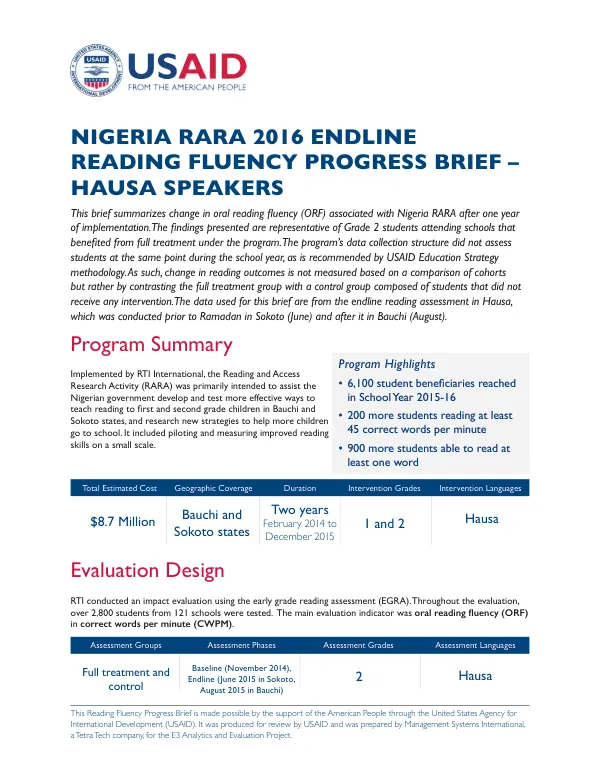
The program aimed to assist the Nigerian government in developing and testing more effective ways to teach reading to first and second-grade children. RARA included piloting and measuring improved reading skills on a small scale. The program reached 6,100 student beneficiaries in School Year 2015-16, with 3,400 males and 2,700 females. At the endline, 900 students (600 males and 300 females) were able to read at least one word, while 200 students (30 males and 30 females) were able to read at least 45 correct words per minute. The total estimated cost of the program was $8.7 million. RARA used the early grade reading assessment (EGRA) tool to evaluate the program's impact. The EGRA tool included oral reading fluency and reading comprehension components. The assessment was conducted near the beginning and end of the school year, with sampling weights used to produce estimates for the population of beneficiaries. The program's main evaluation indicator was oral reading fluency in correct words per minute (CWPM). The assessment groups included a full treatment group and a control group. The assessment phases were baseline (November 2014) and endline (June 2015 in Sokoto and August 2015 in Bauchi). The assessment grades were 2, and the assessment languages were Hausa. The program's results showed that 85 percent of females in the control group scored 0 CWPM, while in the treatment group, this same percentage scored below 10 CWPM. The change in oral reading fluency gain scores for females at the 85th percentile was 10 CWPM. The program also showed that the percentage of non-readers between the control and treatment groups in Grade 2 decreased overall, for males and females by 14, 16, and 14 percentage points, respectively. The program's statistics indicated that the average oral reading fluency increased by 4 CWPM for both males and females, with females showing a greater increase of 5 CWPM. The program's results also showed that the percentage of students with gains of at least 1 CWPM, 5 CWPM, 10 CWPM, and 20 CWPM increased significantly. The program's findings suggest that RARA had a positive impact on oral reading fluency in Grade 2 students in Bauchi and Sokoto states.
Related documents