FEINSTEIN INTERNATIONAL CENTER
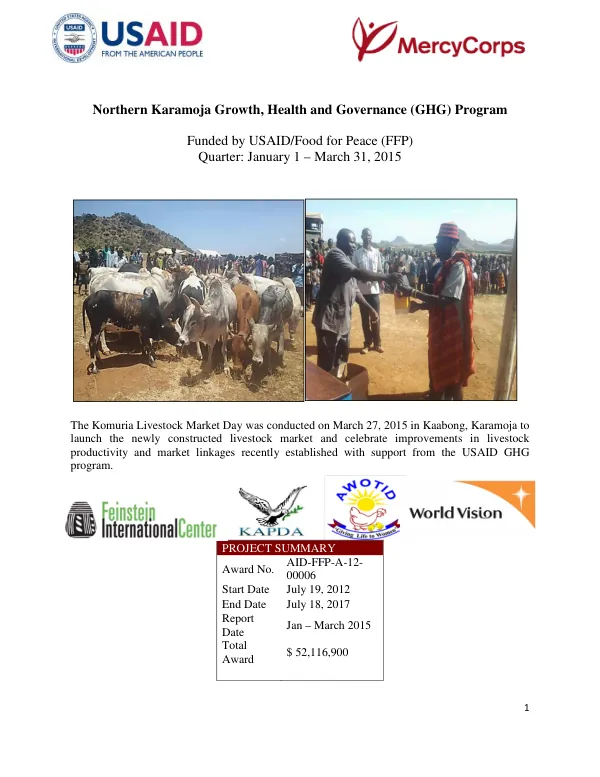
Northern Karamoja Growth, Health and Governance (GHG) Program
The Northern Karamoja Growth, Health and Governance (GHG) Program was designed to capitalize on the pivotal moment in Karamoja's development, leveraging a range of interventions to cement gains in security and build a foundation for broader self-sufficiency.
2017 · 44 pages
Sign in to readA free account is required to download.
Abstract
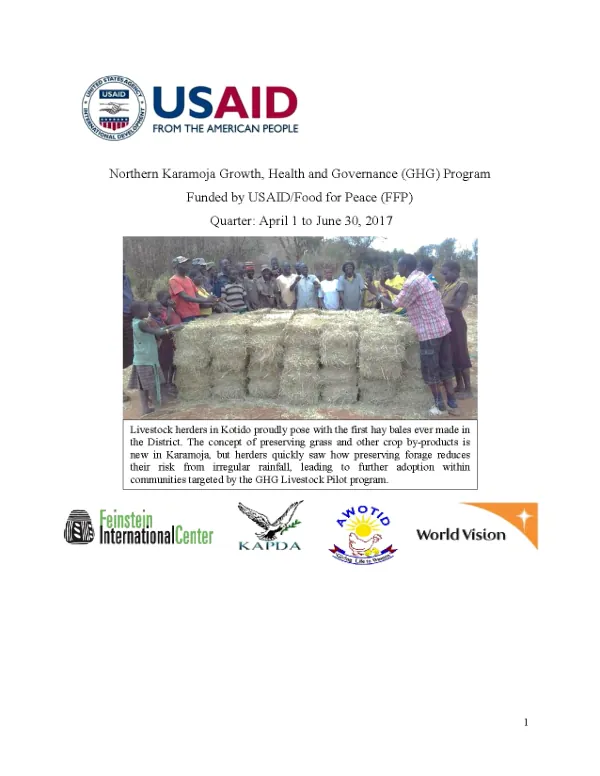
The program expanded in FY16 to include a livestock sector pilot program, examining opportunities for livestock production and marketing in Karamoja's post-conflict development. There is now broad recognition that Karamoja's future will revolve around livestock production. The GHG consortium brings together several complementary capacities, embodied in a facilitative approach that pushes local actors to lead in providing products and services, such as seeds, tools, and pharmaceuticals, as well as extension services, security, and healthcare. Mercy Corps serves as the lead, responsible for the facilitative strategy and quality of programming implemented by the project. World Vision Inc. (WV) leads in commodity management and public health qualifications, conducting community-level health initiatives, behavior change, water, sanitation, and sanitation programming. The Karamoja Peace and Development Agency (KAPDA) and Abim Women Together for Development (AWOTID) spearhead conflict management and governance activities, working with local formal and informal authority structures to bolster local systems for conflict reduction and government service delivery. Six local youth groups complement these efforts, working with communities to reduce harmful practices and behaviors. Tufts University's Feinstein International Center conducts annual evaluations using a community-focused approach, helping consortium partners understand the impact of their work and inform future implementation plans. The GHG program has learned several key lessons and revised its plans and strategies accordingly. Operationalizing the exit strategy for Mother Care Group (MCG) leaders has been a challenge, but government-run health facilities have increasingly recognized the value of MCGs, leading to improved capacity and awareness of their activities. Learning visits and community dialogues have strengthened the relationship between MCGs, local leaders, and health facilities, resulting in increased behavior change and health service utilization. In addition, the program has struggled to implement the new allowance policy adopted by USAID in Uganda, which has affected the implementation of the program. The policy change has required significant adjustments, and the program is working to adapt to the new requirements. The GHG program has made significant progress in its first year, with a focus on building the capacity of local actors and promoting sustainable development. The program has also expanded its geographical focus to include the northernmost three Karamoja districts, as well as Southern Karamoja. The program's facilitative approach has been successful in promoting local ownership and sustainability, and the program is committed to continuing this approach in the coming years. The GHG program has also made significant progress in its health and nutrition interventions, with a focus on improving maternal and child health and reducing malnutrition. The program has worked with local health facilities and community-based organizations to promote health education and behavior change, and has seen significant improvements in health outcomes as a result. In terms of governance and conflict management, the program has worked with local authorities and local authorities to promote peace and stability in the region. The program has also supported the development of local institutions and promoted local ownership and participation in decision-making processes. Overall, the GHG program has made significant progress in its first year, with a focus on building the capacity of local actors and promoting sustainable development. The program is committed to continuing this approach in the coming years and to making a lasting impact in the lives of the people of Karamoja.
Related documents