IREX
Novateca Program Impact Assessment Study
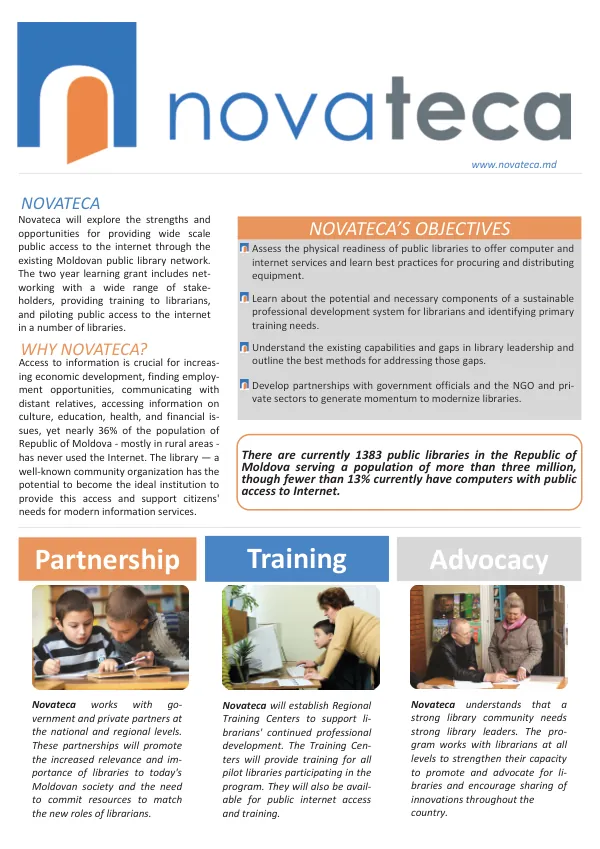
The Novateca program was launched in 2014 by IREX in cooperation with USAID and funded by the Bill & Melinda Gates Foundation.
2018 · 31 pages
Sign in to readA free account is required to download.
Abstract
The program aimed to transform the Moldovan public library network into a powerful driver of social and economic change. The objective was to revamp the traditional function of the Moldovan library as a repository of physical knowledge and catapult it into the 21st century by equipping it with modern technology and providing a diverse range of services. The program's main achievements include an increase in the number of people using library services, with visitors using the services more frequently. Renovated, comfortable spaces and free access to the internet have drawn in more visitors, making libraries better equipped to assess community needs and respond to them adequately. Libraries have become stronger, better connected, and more influential institutions, with librarians enhancing their standing in the community and establishing partnerships with local stakeholders. The program has also shifted traditional perceptions and expectations of libraries' role, with libraries increasingly perceived as more than mere repositories of physical knowledge. Libraries enjoy greater public recognition and support, with communities appreciating and valuing the services provided by the public library. The professional standing of librarians has increased as they became a driving force within the community. The program's impact on the qualifications, health, academic performance, earnings, and civic participation of its visitors has increased. Visitors consistently reported that accessing the services provided by the public libraries had a beneficial impact upon their lives. Better services meant more educational opportunities and support, more involvement in the community, more access to information for personal or business purposes, more support in finding employment, and less time and money spent on accessing public services. Library modernization has provided greater access to information and targeted services to people with special needs, contributing to broader social inclusion. As a result of the program, more people with special needs benefited from library services, and about half of them mentioned visible improvements in library accessibility for people with special needs. Prior to the beginning of the program, two baseline studies revealed the state of public libraries in 2011. The qualitative data showed that the public saw the library as an unattractive, grim, dark, and unfriendly space, especially for young people. Librarian absenteeism was a common practice, and often there was no librarian at all, particularly in rural areas. About 80% of the library's visitors reported that they visited the library only once a year. The predominant view of the library was as a place where people go to read books, with only 12% using computers and 11% using the internet. The program's achievements are particularly remarkable given the country's socioeconomic conditions, including a shrinking population due to emigration. The program's success is attributed to the factors that have contributed to its success, including the use of ICT and facilities, skilled librarians, services, and partnerships. The program's impact is evident in the increase in the number of visitors and their diversity, which attest to the fact that the libraries have made a great deal of progress in becoming genuine community centers. The program's success has also led to the establishment of partnerships with other community players, making the library a central institution in community life, particularly in rural areas. The program's methodology involved regular studies to track the progress in achieving its core objectives, with the use of historical quantitative and qualitative data collected between 2011 and 2017, administrative data made available by the program, and qualitative data collected specifically for this assignment in 2018. The conclusions of the report are based on the analysis of the data collected, which provides an evidence-based overview of the impact the Novateca program had on Moldova's libraries.
Related documents