USAID DEC
Observations and Local Knowledge of Urial (Ovis orientalis) on the Bamiyan Plateau, Central Afghanistan
Sign inWILDLIFE CONSERVATION SOCIETY
Observations and Local Knowledge of Urial (Ovis orientalis) on the Bamiyan Plateau, Central Afghanistan
The Bamiyan Plateau in central Afghanistan is home to a population of urial (Ovis orientalis), a species of wild sheep.
2014 · 11 pages
Sign in to readA free account is required to download.
Abstract
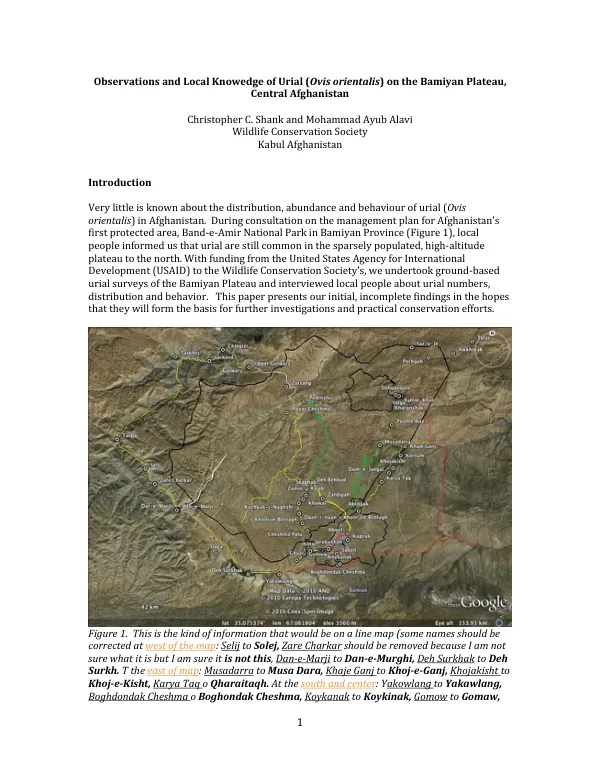
The plateau is a high-altitude region with rolling hills, valleys, and steep canyons, bounded by the northwestern part of the Yakawlang Valley, the Dar-e-Aw River, and the town of Yakowlang. The area is approximately 6000 square kilometers in size and is comprised of high-altitude terrain, with elevations ranging from 3000 to 4000 meters. The urial population in the Bamiyan Plateau is believed to be Ovis orientalis cycloceros, a subspecies that is native to Afghanistan. The species was once widespread in the country, but its distribution has been significantly reduced due to habitat loss and hunting. The current distribution of urial in Afghanistan is not well understood, with most records dating back to the 1970s. Recent sightings have been reported in the Wakhan Valley and in Badakhshan Province, but these are isolated and not representative of the species' overall distribution. The Bamiyan Plateau is a unique conservation opportunity due to its large size and lack of permanent settlements. The area is primarily a shrub steppe, dominated by species of Acantholimon and Artemisia, with annual above-ground production estimated to be around 880-kg ha-1. The plateau has been grazed for centuries, and all areas show the effects of grazing to a greater or lesser extent. Between May 2008 and October 2009, researchers conducted foot surveys and interviewed villagers in the area to gather information on the urial population. During this time, they saw 55 urial at elevations ranging from 3000 to 3750 meters, and several urial horns were picked up on the plateau. The researchers also deployed temperature data loggers at Jarukushan and Dehqanqala, which provided data on temperature and precipitation patterns in the area. The temperature data loggers showed that the coldest monthly average temperature at Band-e-Amir was -12.2°, with an absolute minimum temperature of -34.2°. The warmest monthly average temperature was 18.7°, with an absolute maximum of 32.2°. In contrast, the coldest monthly average temperature at Ajar was -0.4°, with an absolute minimum temperature of -10.4°. The warmest monthly average temperature was 26.7°, with an absolute maximum of 36.8°. The researchers also used the normalized difference vegetation index (NDVI) to calculate dates of snow cover, initial green-up, and maximum green vegetation for the years 2000 to 2004 and 2008-2009 at Band-e-Amir and Ajar. The results showed that Band-e-Amir is typically snow-covered from about November 17 to March 6, while the duration of snow cover at Ajar is 2-4 weeks less. Green-up initiated about 22 March at Band-e-Amir and reached its peak on June 26, on average. At Ajar, green-up started at a mean date of about 6 March and reached a peak around June 15. The researchers believe that the urial population in the Bamiyan Plateau is likely to be found in the areas with the highest elevations and most suitable habitat. The area is primarily used seasonally, with most settlements located at lower elevations at the edge of the plateau. The lack of permanent settlements presents a unique conservation opportunity, and further research is needed to understand the distribution and behavior of the urial population in the area.