USAID DEC
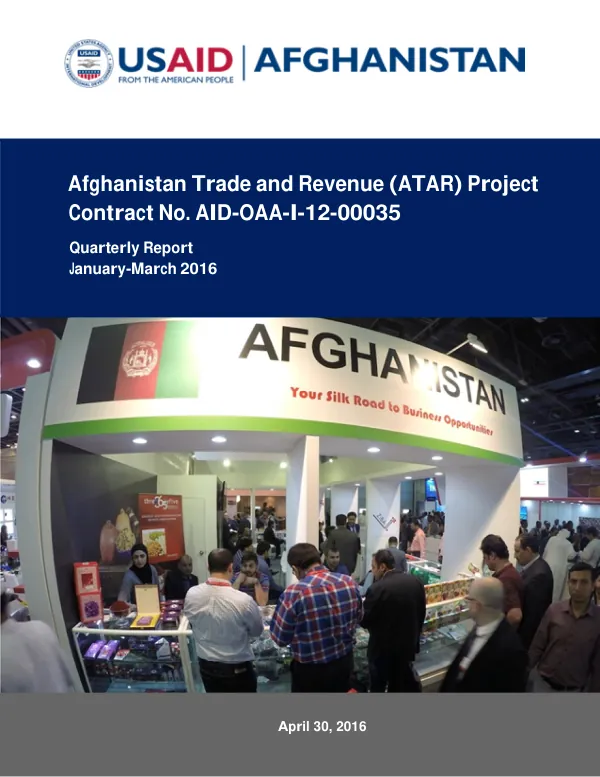
Afghanistan Trade and Revenue (ATAR) Project Quarterly Report for January-March 2016
Sign inCHEMONICS
Afghanistan Trade and Revenue (ATAR) Project Quarterly Report for January-March 2016
Afghanistan Trade and Revenue (ATAR) Project Quarterly Report for January-March 2016 highlights the ongoing efforts to support Afghanistan's integration into the international trading community.
2016 · 49 pages
Sign in to readA free account is required to download.
Abstract
The project, implemented by Chemonics in partnership with the Economic Integration Forum (EIF), aims to help Afghanistan realize its full potential in the global trading market. The ATAR project, which began on November 7, 2013, and will end on November 6, 2017, is based in Kabul and has staff in Mazar-e Sharif, Herat, and Jalalabad to support regional customs activities. Additionally, the project has a presence in Tajikistan, Kyrgyzstan, Turkmenistan, and Uzbekistan to strengthen Afghanistan's ties in Central Asia. ATAR also supports the Afghan government and Afghanistan's traders in improving linkages with India and Pakistan. To achieve its goal, ATAR is assisting the government in integrating Afghanistan into the international trading community through membership in the World Trade Organization (WTO). The project is also revamping customs procedures to reap the full benefits of regional and international trade. This improved business climate is expected to pave the way for private investment, enhanced trade, job creation, and fiscal sustainability in the country. The ATAR project is achieving its goal through three components: Component 1, Component 2, and Component 3. Component 1, Support Trade Policy Liberalization, promotes liberalization of Afghanistan's trade regime by supporting its accession to the WTO. This support is accomplished by building capacity and providing technical assistance within implementing institutions to conduct negotiations, draft legislation, and institute reforms required to improve the trade regime in the region and meet WTO requirements. Component 2, Facilitate Enhanced Access to Regional Markets, focuses on facilitating Afghanistan's access to regional markets, including those in Central Asia, India, and Pakistan. The component aims to strengthen Afghanistan's ties with its regional partners and improve its trade relationships with these countries. This is achieved through various activities, including trade policy analysis, trade facilitation, and capacity building. Component 3, Improved Customs Administration, aims to improve the efficiency and effectiveness of Afghanistan's customs administration. This is achieved through various activities, including support for regional integration, organizational compliance, trade compliance, and capacity building. The component also focuses on strengthening the capacity of the Afghan Customs Department (ACD) and improving its ability to implement customs procedures and regulations. The ATAR project has made significant progress in the first quarter of 2016, with various activities implemented across the three components. These activities include support for the WTO accession process, trade policy analysis, trade facilitation, and capacity building. The project has also made progress in improving the efficiency and effectiveness of Afghanistan's customs administration, including the implementation of new customs procedures and regulations. Overall, the ATAR project is making significant contributions to Afghanistan's economic development and integration into the international trading community. The project's efforts to support trade policy liberalization, facilitate enhanced access to regional markets, and improve customs administration are expected to have a positive impact on the country's economy and trade relationships with its regional partners.