USAID DEC
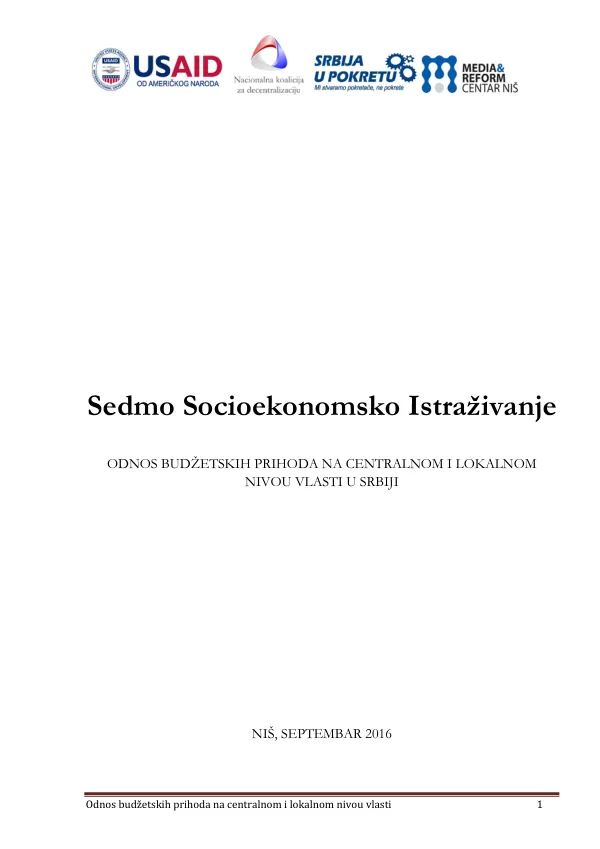
Odnos budžetskih prihoda na centralnom i lokalnom nivou vlasti u Srbiji
The relationship between budget revenues at the central and local levels of authority in Serbia is a topic of ongoing debate.
2016 · 16 pages
Sign in to readA free account is required to download.
Abstract
According to data from the Ministry of Finance, the share of budget revenues at the local level has been steadily decreasing over the past few years. In 2012, local authorities accounted for 17.7% of total budget revenues, while in 2015, this share decreased to 11.68%. In contrast, the central level of authority has consistently accounted for a larger share of budget revenues, with 82.83% in 2012 and 88.32% in 2015. This trend is in stark contrast to many European countries, where a significant share of budget revenues is allocated to local authorities. In 2015, the average share of budget revenues allocated to local authorities in the European Union was 31.6%. Countries such as Finland, Denmark, and Sweden, which are known for their high standard of living, allocate a significant share of their budget revenues to local authorities, with 47.9%, 47.7%, and 45.6% respectively. The European Charter on Local Self-Government, which Serbia ratified in 2007, emphasizes the importance of local self-government and the allocation of financial resources to local authorities. The charter states that local authorities should have the power to collect taxes and fees, and that a significant share of their financial resources should come from local sources. In contrast, the current situation in Serbia is characterized by a high degree of centralization, with the central level of authority controlling a significant share of budget revenues. This has led to concerns about the autonomy of local authorities and their ability to effectively manage their own finances. The Ministry of Finance has reported that the share of budget revenues allocated to local authorities has been decreasing over the past few years, with a significant decline in 2015. This trend is likely to continue, as the government has announced plans to further reduce the share of budget revenues allocated to local authorities. The consequences of this trend are far-reaching, with potential impacts on the autonomy of local authorities, the effectiveness of public services, and the overall quality of life for citizens. The government's decision to reduce the share of budget revenues allocated to local authorities has been met with criticism from local authorities and civil society organizations, who argue that it undermines the principles of local self-government and decentralization. The situation in Serbia is not unique, as many countries in the region are facing similar challenges. However, the country's commitment to decentralization and local self-government, as enshrined in the European Charter on Local Self-Government, makes it all the more important to address these challenges and ensure that local authorities have the resources and autonomy they need to effectively serve their citizens. The government's decision to reduce the share of budget revenues allocated to local authorities has been justified as a necessary measure to address the country's fiscal deficit. However, critics argue that this approach is short-sighted and will ultimately undermine the effectiveness of public services and the overall quality of life for citizens. The situation in Serbia highlights the need for a more nuanced approach to decentralization and local self-government. While the government's commitment to decentralization is welcome, it is essential to ensure that local authorities have the resources and autonomy they need to effectively serve their citizens. This requires a more balanced approach to budget allocation, one that takes into account the needs and priorities of local authorities and the citizens they serve. In conclusion, the relationship between budget revenues at the central and local levels of authority in Serbia is a complex and multifaceted issue. While the government's commitment to decentralization is welcome, the current trend of reducing the share of budget revenues allocated to local authorities is a cause for concern. The consequences of this trend are far-reaching, with potential impacts on the autonomy of local authorities, the effectiveness of public services, and the overall quality of life for citizens.