USAID DEC
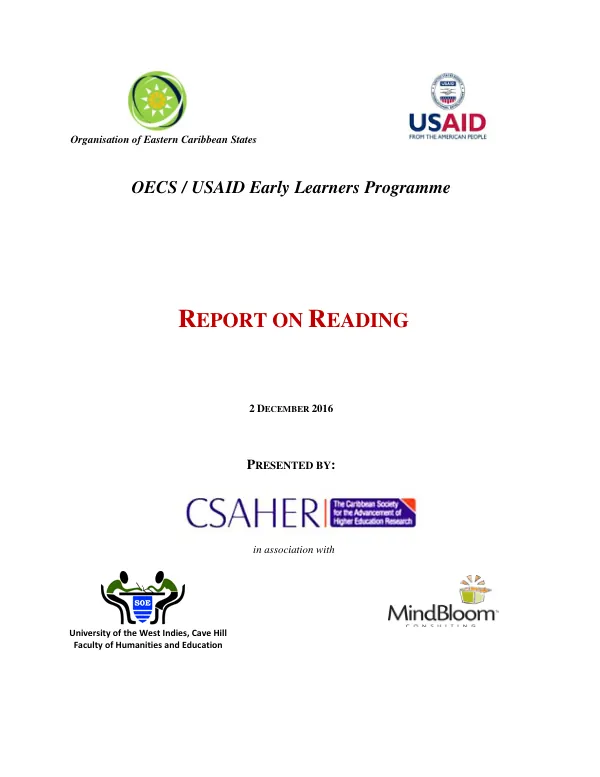
OECS/USAID Early Learners Programme – Report on Reading
The OECS/USAID Early Learners Programme is a collaborative initiative aimed at enhancing literacy skills among early learners in the Eastern Caribbean.
2016 · 295 pages
Sign in to readA free account is required to download.
Abstract
The programme was launched in 2016, with the primary objective of improving reading outcomes among children in the region. The programme is a joint effort between the Organisation of Eastern Caribbean States (OECS) and the United States Agency for International Development (USAID). The programme's scope encompasses six OECS member states, including Antigua and Barbuda, Dominica, Grenada, Saint Lucia, St. Kitts and Nevis, and St. Vincent and the Grenadines. The programme's focus on early literacy is critical, as research has shown that early reading skills are a strong predictor of future academic success. A team of specialists from the Caribbean Society for the Advancement of Higher Education Research (CSAHER) and MindBloom Consulting Limited conducted a comprehensive assessment of reading instruction in the region. The assessment involved a review of international and regional best practices in reading instruction, as well as an evaluation of current language policies and curricula in the six OECS member states. The assessment methodology employed a mixed-methods approach, combining both quantitative and qualitative data collection and analysis techniques. The team conducted a review of existing literature on reading instruction, as well as interviews with education officials, teachers, and school administrators in the six OECS member states. The report highlights several key findings, including the need for a more comprehensive and coordinated approach to reading instruction in the region. The assessment also identified a range of challenges facing educators and policymakers in the OECS member states, including limited resources, inadequate teacher training, and a lack of standardized assessment tools. The report provides a detailed analysis of international and regional best practices in reading instruction, highlighting the importance of phonics-based instruction, explicit teaching of reading strategies, and the use of technology to support reading development. The report also provides a summary of current language policies and curricula in the six OECS member states, highlighting areas of strength and weakness. The programme's implementation details are outlined in the report, including the establishment of a regional reading framework, the development of teacher training programmes, and the provision of resources and support to schools and educators. The report also highlights the importance of ongoing monitoring and evaluation to ensure the programme's effectiveness and impact. The report's geographic focus is on the six OECS member states, with a particular emphasis on the challenges and opportunities facing educators and policymakers in these countries. The report's timeframes are not explicitly stated, but it is clear that the programme is a long-term initiative aimed at improving reading outcomes among early learners in the region. The report's recommendations are based on the assessment findings and are aimed at improving reading instruction in the OECS member states. The recommendations include the development of a regional reading framework, the provision of teacher training and support, and the establishment of a system for ongoing monitoring and evaluation. The report also highlights the importance of collaboration and coordination among educators, policymakers, and other stakeholders in the region to achieve the programme's objectives.
Related documents