PATRIMONIO NATURAL
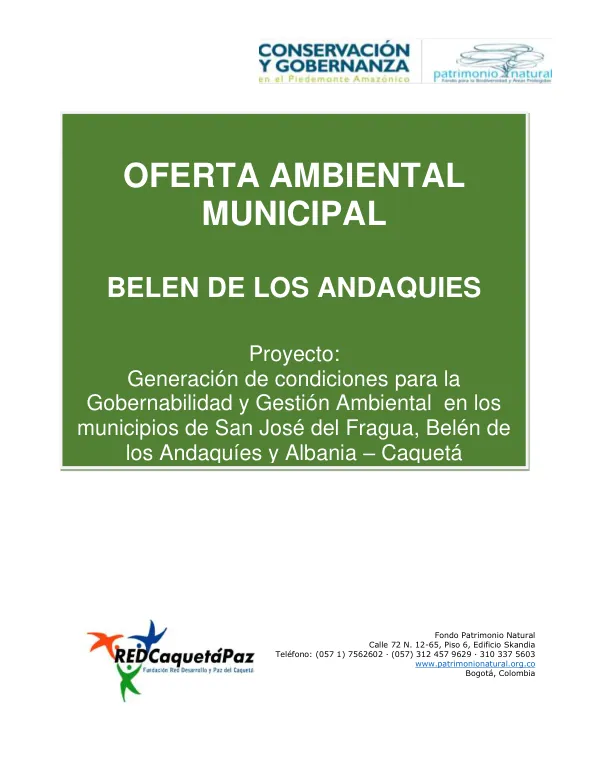
Oferta Ambiental Municipal de Belén de los Andaquíes
The agricultural development initiative in Belén de los Andaquíes, a municipality in the department of Caquetá, Colombia, is part of a broader project aimed at promoting sustainable governance and environmental management in the region.
2015 · 26 pages
Sign in to readA free account is required to download.
Abstract
The initiative focuses on generating conditions for effective governance and environmental management in the municipalities of San José del Fragua, Belén de los Andaquíes, and Albania – Caquetá. The municipality of Belén de los Andaquíes was founded in 1917 by the Capuchin friar Jacinto María De Quito, and its name honors the indigenous Andaquíes people who inhabited the area. Initially, the territory was part of the municipalities of Curillo, San José del Fragua, Morelia, and Albania, but it has since undergone significant changes, including the loss of its indigenous population due to the extraction of quina and caucho in the mid-20th century. Belén de los Andaquíes is located in the southern part of Colombia, approximately 43 kilometers from the city of Florencia, and covers an area of approximately 1,111 square kilometers. The municipality is situated in the piedmont Amazonian region, extending from the Andean region to the Amazonian plain, and is characterized by a diverse geography, with mountains, rivers, and forests. The municipality's geography and climate support a wide range of ecosystems, including tropical rainforests, cloud forests, and savannas. The region is home to a rich biodiversity, with many species of plants and animals found nowhere else in the world. However, the municipality also faces significant environmental challenges, including deforestation, soil erosion, and water pollution. The project aims to address these challenges by promoting sustainable land use practices, conserving biodiversity, and improving the management of natural resources. The initiative will focus on three key areas: sustainable agriculture, conservation of natural resources, and community development. The project will also involve the participation of local communities, civil society organizations, and government institutions to ensure that the initiative is effective and sustainable in the long term. The project will be implemented through a series of activities, including the development of a municipal environmental plan, the establishment of protected areas, and the promotion of sustainable agriculture practices. The initiative will also involve the training of local communities in environmental management and the provision of technical assistance to support the implementation of the project. The project has the potential to make a significant contribution to the conservation of biodiversity and the sustainable management of natural resources in the region. However, its success will depend on the effective participation of local communities, civil society organizations, and government institutions, as well as the availability of resources and technical assistance. The municipality of Belén de los Andaquíes has a rich cultural heritage, with a strong indigenous presence and a history of colonization. The municipality is home to several indigenous communities, including the Andaquíes, who have a unique culture and language. The municipality is also home to several archaeological sites, including the ruins of the ancient city of Belén de los Andaquíes. The municipality's economy is primarily based on agriculture, with crops such as coffee, cocoa, and bananas being major exports. However, the municipality also has a significant mining industry, with gold and other minerals being extracted from the region. The municipality's economy is also supported by tourism, with visitors attracted to the region's natural beauty and cultural heritage. The municipality of Belén de los Andaquíes faces several challenges, including poverty, inequality, and lack of access to basic services such as healthcare and education. The municipality also faces environmental challenges, including deforestation, soil erosion, and water pollution. However, the municipality has a strong sense of community and a commitment to sustainable development, which will be essential for the success of the project. The project will be implemented in partnership with local communities, civil society organizations, and government institutions. The project will also involve the participation of international organizations and experts in sustainable development and environmental management. The project will be funded through a combination of government and international funding, as well as private sector investment.
Related documents