USAID DEC
Operational Guidance for Maternal and Child Survival Country Programs: In-Service Clinical Training
Sign inJHPIEGO
Operational Guidance for Maternal and Child Survival Country Programs: In-Service Clinical Training
The Maternal and Child Survival Program (MCSP) has developed operational guidance for in-service clinical training of health care providers.
2016 · 4 pages
Sign in to readA free account is required to download.
Abstract
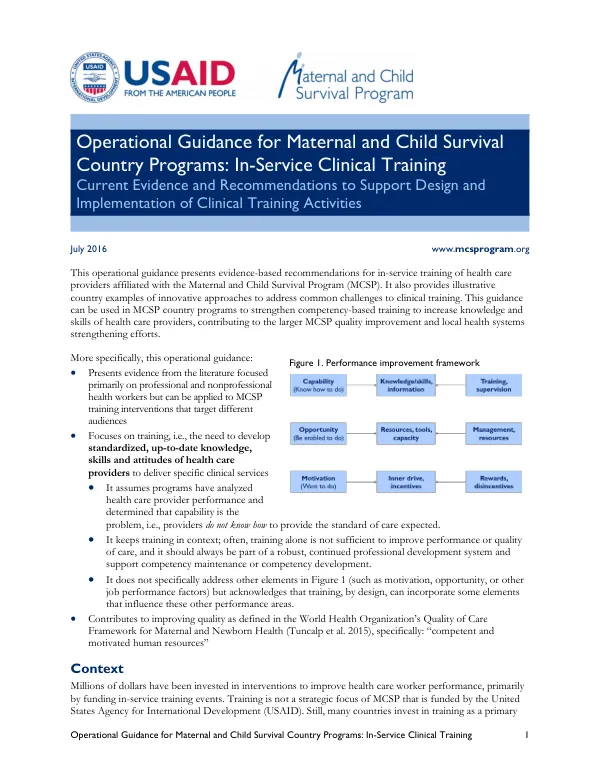
This guidance presents evidence-based recommendations for strengthening competency-based training to increase knowledge and skills of health care providers. The primary focus is on developing standardized, up-to-date knowledge, skills, and attitudes of health care providers to deliver specific clinical services. The guidance emphasizes the importance of training in context, considering the workplace and expected performance of health care providers. It highlights common challenges to clinical training, including training that is disconnected from the workplace, sending providers for training that disrupts services, and providers' new knowledge and skills not being fully applied in their workplace. The guidance also notes that pre-service education is not always competency-based, resulting in in-service training often teaching the basics to top up skills. A literature review conducted by Jhpiego found that training alone is not sufficient to improve performance or quality of care. The review suggests that training should be one piece of a robust, continued professional development program and linked to maintaining or developing a new competency. The guidance also emphasizes the importance of including four essential elements of clinical training in any training design: transfer of knowledge, skills acquisition and practice, coaching for an experienced provider or trainer, and assessment of skills. The guidance highlights the effectiveness of interactive techniques, such as case studies, role-plays, and simulations, which are more effective than lectures in changing practice behaviors. It also notes that techniques that do not fully engage the learner in critical thinking are unlikely to change practice behaviors. The guidance provides examples of innovative approaches to clinical training, including the use of simulation-based training, blended learning, and low-dose, high-frequency training. In terms of setting, the guidance emphasizes the importance of workplace-based training, where the training setting is similar to the health care provider's work environment. This allows for sufficient, realistic practice opportunities similar to the workplace. The guidance also notes that on-the-job training has the added benefit of helping identify barriers to implementing new practices, improving worker productivity, and increasing cost-effectiveness. The guidance concludes that in-service clinical training should be designed to be low-dose, high-frequency, with providers trained in smaller "chunks" of content to make the content easier to learn and retain. This approach prioritizes simulation, practice, and feedback as the primary techniques. The guidance provides examples of successful implementation of low-dose, high-frequency training, including the Helping Babies Breathe program.
Related documents