JHPIEGO
Madhya Pradesh | State Factsheet
Madhya Pradesh has a population of 72.6 million, according to the 2011 census.
2018 · 1 pages
Sign in to readA free account is required to download.
Abstract
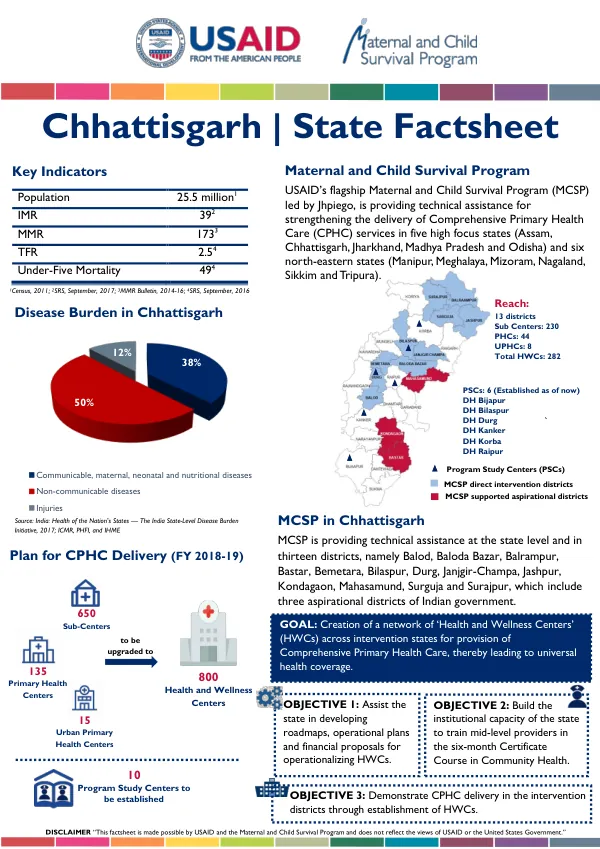
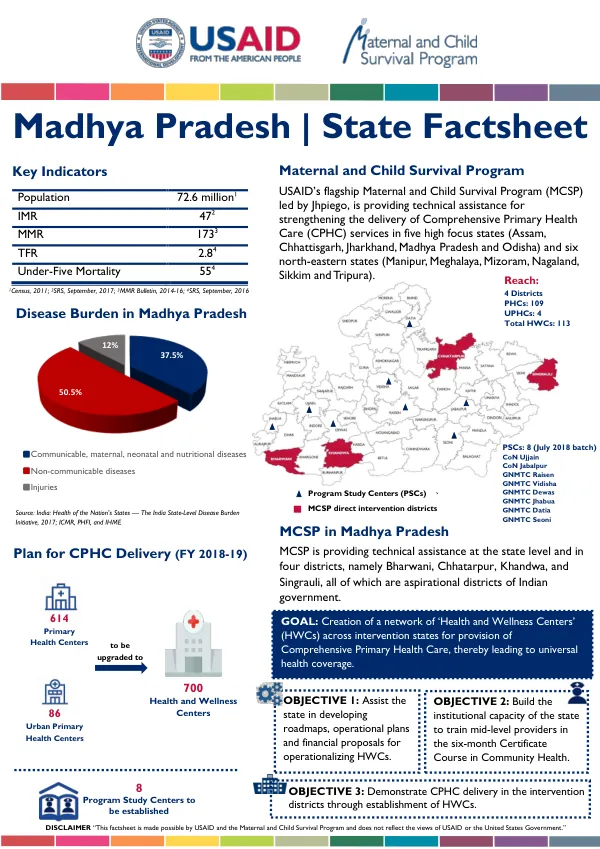
Key health indicators for the state include an infant mortality rate (IMR) of 472, a maternal mortality rate (MMR) of 173, a total fertility rate (TFR) of 2.84, and an under-five mortality rate of 554. The state is one of the five high focus states, along with Assam, Chhattisgarh, Jharkhand, and Odisha, where USAID's flagship Maternal and Child Survival Program (MCSP) is providing technical assistance for strengthening Comprehensive Primary Health Care (CPHC) services. The goal of the program in Madhya Pradesh is to create a network of Health and Wellness Centers (HWCs) across the state for provision of CPHC services, leading to universal health coverage. The program has three objectives: assisting the state in developing roadmaps, operational plans, and financial proposals for operationalizing HWCs; building the institutional capacity of the state to train mid-level providers in the six-month Certificate Course in Community Health; and demonstrating CPHC delivery in intervention districts through establishment of HWCs. The program is providing technical assistance at the state level and in four districts, namely Bharwani, Chhatarpur, Khandwa, and Singrauli, all of which are aspirational districts of the Indian government. The program aims to upgrade 614 Primary Health Centers to Health and Wellness Centers, establish 8 Program Study Centers, and demonstrate CPHC delivery in the intervention districts. The program has also established 113 HWCs, including 109 PHCs and 4 UPHCs, in four districts. The disease burden in Madhya Pradesh is significant, with communicable, maternal, neonatal, and nutritional diseases accounting for 37.5% of the total disease burden, non-communicable diseases accounting for 50.5%, and injuries accounting for 12%. The program aims to address these health challenges through the establishment of HWCs and provision of CPHC services. The program has made significant progress in Madhya Pradesh, with 8 Program Study Centers established in July 2018. The program has also trained mid-level providers in the six-month Certificate Course in Community Health, and has demonstrated CPHC delivery in the intervention districts through the establishment of HWCs. The program aims to continue its efforts to strengthen CPHC services in Madhya Pradesh and improve the health outcomes of the state's population.
Related documents