CATHOLIC RELIEF SERVICES (CRS)
Operational program grant proposal : integrated pre-school feeding program
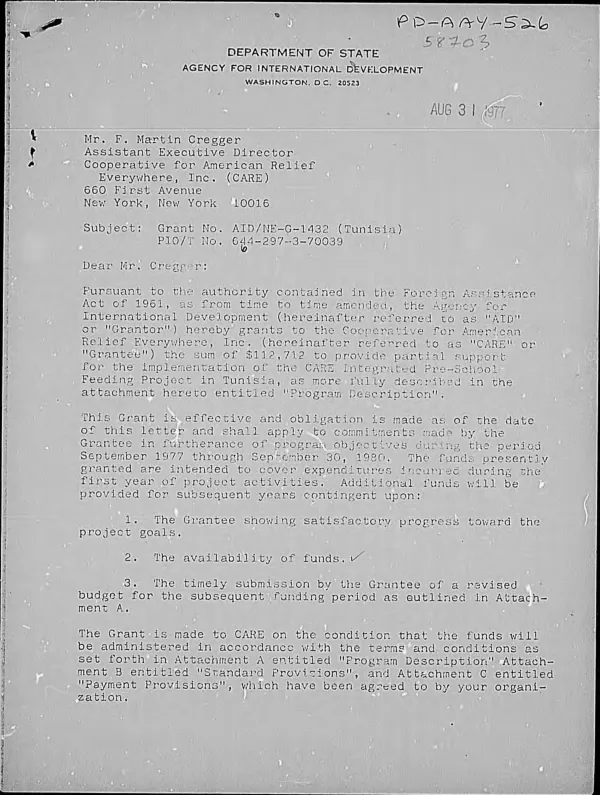
OPG to Catholic Relief Services (CRS) to upgrade its pre-school feeding program in Tunisia and integrate it with public health care/health education activities.
1977
Sign in to readA free account is required to download.
Abstract
Several host country institutions will assist in project implementation. To improve its pre-school feeding program, CRS will work with the National Committee for Social Solidarity (NCSS), the Ministry of Social Welfare (MSW), and PCV nutritionists to: improve the quality of the meals (type and means of preparation) served at the feeding centers; provide necessary kitchen and dining furniture and equipment; upgrade physical plants for storing, preparing, and serving the food; and improve the monitoring of feeding centers" operations. The project will also analyze common dietary deficiencies and seek to relieve them by promoting parent-operated gardens, and examine the logistical problems which cause waste and feeding interruptions. The pre-school program will be integrated with public health and environmental/nutritional education activities. Specifically, public health nurses (PHN"s) from the Ministry of Health (MOH) will: (1) conduct age-weight and anthropometric measuring of children enrolled in the feeding program, of their younger siblings, and of others to the extent that their mothers participate; and (2) institute regular immunizations and periodic health check-ups and doctor referrals, as well as pre- and post-natal care for mothers and their newborn children. In addition, social workers from CRS, NCSS, MSW, and the National Institute of Nutrition will instruct women in: (1) nutrition, especially diet during pregnancy and illness; (2) sanitation and food handling procedures; (3) low-cost, nutritionally balanced meals made from local crops; and (4) child care (breastfeeding, weaning). The social workers will conduct these activities not on a house-to-house basis, as is usual, but on a group basis at the center; this will enable both them and the PHN"s to establish more constant and earlier contact with high-risk children.