USAID. MISSION TO LIBERIA
Opportunities Industrialization Centers - OPG
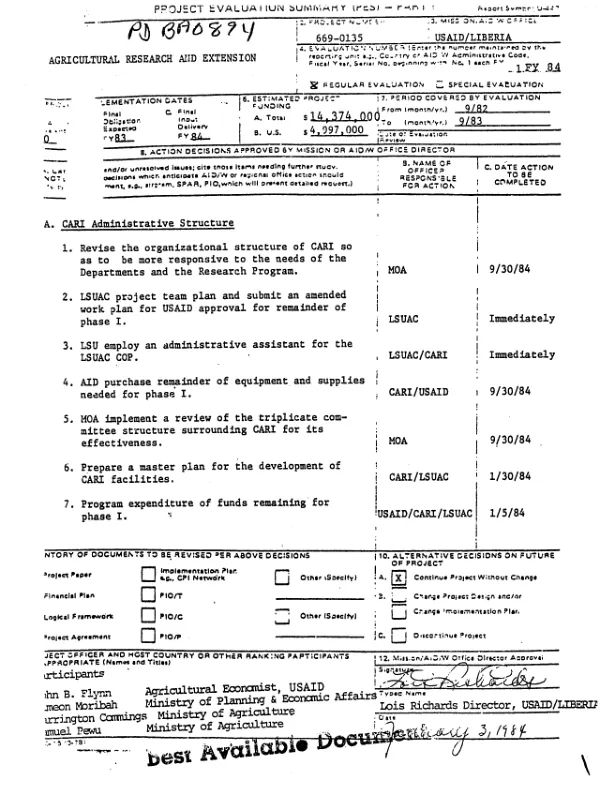
Summarizes unattached external evaluation (PD-AAT-971) of an OPG to Opportunities Industrialization Centers International (OICI) to institutionalize a vocational training (VT) center in Liberia.
Tolle, Edwin R.; Nguyen, Quy D. · 1984
Sign in to readA free account is required to download.
Abstract
The evaluation covered the period 12/82-10/83 and was based on document review, interviews with all professional and management staff and with on-the-job graduates, and site visits. Despite Liberia"s deteriorating economy and the political turmoil surrounding the 1979 rice riots and the 1980 military coup, the project is generally meeting or exceeding its objectives, all of which should essentially be achieved by the revised PACD of 9/30/84. (Since this is so, the evaluation recommendation for a 6-12 month extension should be thoroughly justified on a basis other than unexpended funds.) Currently, fully operational courses are being offered in carpentry, masonry, electricity, air conditioning and refrigeration, plumbing, and auto mechanics, and courses in bookkeeping and driver training will be offered after the scheduled 5/84 completion of the permanent training center in Monrovia; also, all programs will be open to female students at that time. To date, 499 trainees have graduated and over 80% of these now hold full-time jobs. Although the Industrial Advisory Council was disbanded at the time of the military coup (it should be reactivated), the Board of Directors is functioning very well, as are all skills training personnel and the TA and management teams. On the negative side, attempts to make personnel and operational changes in the Student Services (i.e., placement) Unit - which remains, as noted in the 1979 and 1980 evaluations, the one element of the program in serious need of improvement - have been ineffective due to the fact that the Unit"s manager is the wife of the Deputy Minister of Youth and Sports (who is the project"s liaison with that Ministry.) In any case, significant increases in placement will be difficult to realize unless the economy improves. The project developed, to a fairly high degree, three closely related elements often lacking in VT programs: (1) the ability to recruit students who truly wish to become skilled technicians and not simply use the program as a bridge to further academic training; (2) a workable mix of theory, hands-on experience, and early on-the-job follow-up; and (3) a stress on personal satisfaction in skilled performance. The project will become an effective means for upgrading the Liberian labor force if the question of ongoing financial viability can be effectively addressed through better fundraising and use of contingency planning.
Related documents