USAID DEC
Opposite latitudinal patterns for bird and arthropod predation revealed in experiments with differently colored artificial prey
Sign inUSAID DEC
Opposite latitudinal patterns for bird and arthropod predation revealed in experiments with differently colored artificial prey
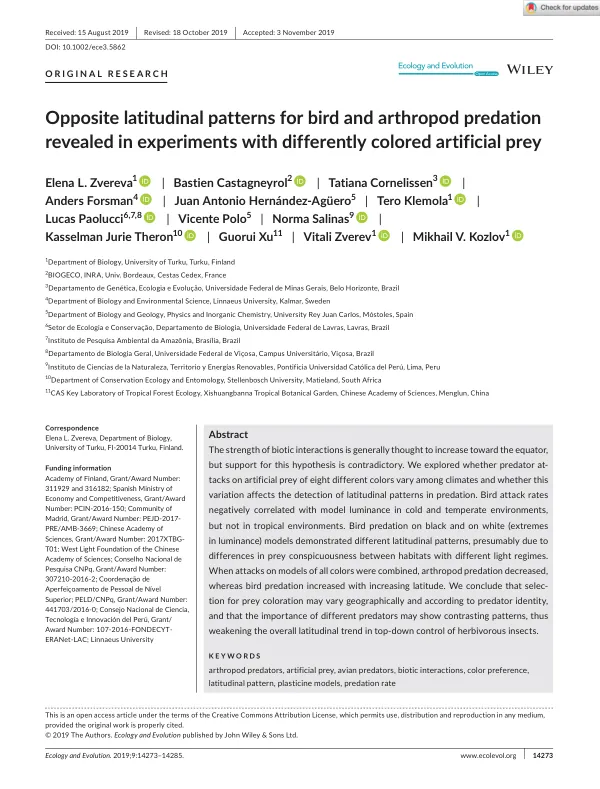
The strength of biotic interactions is generally thought to increase toward the equator, but support for this hypothesis is contradictory.
2019 · 13 pages
Sign in to readA free account is required to download.
Abstract
To explore this phenomenon, researchers conducted experiments with artificial prey of eight different colors to examine whether predator attacks vary among climates and whether this variation affects the detection of latitudinal patterns in predation. Bird attack rates negatively correlated with model luminance in cold and temperate environments, but not in tropical environments. Bird predation on black and on white models demonstrated different latitudinal patterns, presumably due to differences in prey conspicuousness between habitats with different light regimes. When attacks on models of all colors were combined, arthropod predation decreased, whereas bird predation increased with increasing latitude. The study suggests that selection for prey coloration may vary geographically and according to predator identity, and that the importance of different predators may show contrasting patterns, thus weakening the overall latitudinal trend in top-down control of herbivorous insects. The researchers propose that the use of a set of different prey items, rather than prey of one type, would generate more robust inferences regarding variation in predation rates among different environments. The study's findings have implications for understanding the factors shaping global latitudinal patterns in predator-prey interactions. The results highlight the importance of considering the role of different predators and their responses to prey coloration in different environments. The study also underscores the need for a more nuanced understanding of the complex interactions between predators and prey, and the ways in which these interactions vary across different climates and habitats. The researchers used a combination of artificial prey and field experiments to examine the effects of predator identity and prey coloration on predation rates. The study was conducted at multiple sites across different climates, including tropical, temperate, and cold environments. The results of the study provide new insights into the factors shaping global latitudinal patterns in predator-prey interactions, and highlight the need for further research in this area. The study's findings have implications for our understanding of the complex interactions between predators and prey, and the ways in which these interactions vary across different climates and habitats. The results of the study provide new insights into the factors shaping global latitudinal patterns in predator-prey interactions, and highlight the need for further research in this area.