USAID DEC
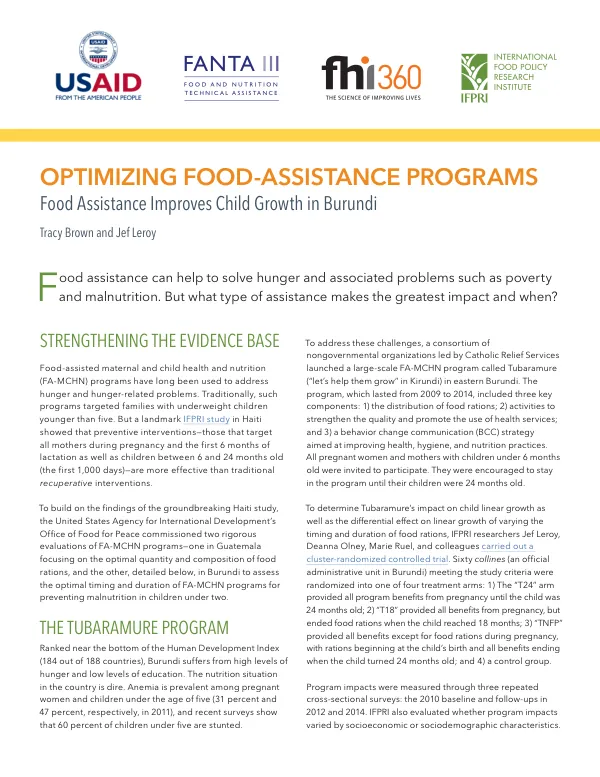
Optimizing Food-Assistance Programs: Food Assistance Improves Child Growth in Burundi
Sign inFHI 360
Optimizing Food-Assistance Programs: Food Assistance Improves Child Growth in Burundi
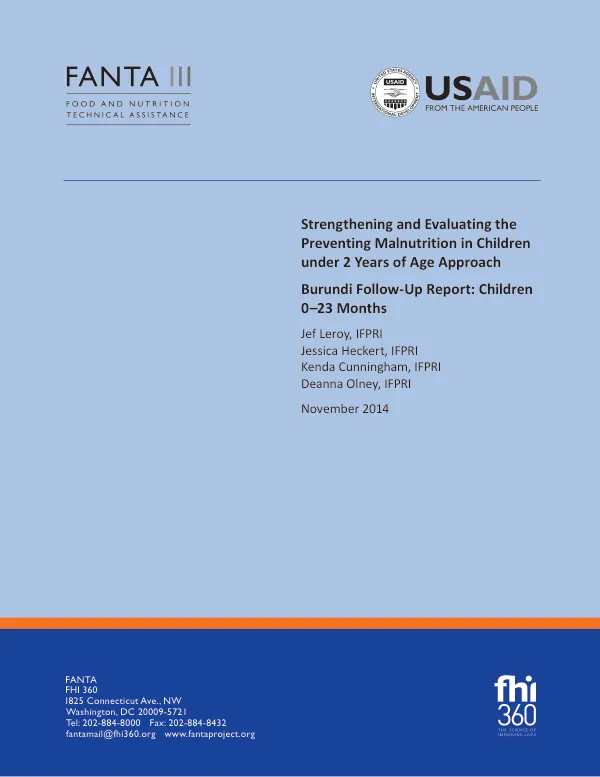
The agricultural development initiative in Burundi began in 2009 to address hunger and malnutrition among children under two.
2018 · 2 pages
Sign in to readA free account is required to download.
Abstract
The program, called Tubaramure, was a food-assisted integrated health and nutrition intervention that included three key components: distribution of food rations, activities to strengthen the quality and use of health services, and a behavior change communication strategy to improve health, hygiene, and nutrition practices. The program was implemented in eastern Burundi, where 60 clusters were randomized into one of four treatment arms: T24, T18, TNF, and a control group. The T24 arm provided all program benefits from pregnancy until the child was 24 months old, while the T18 arm ended food rations when the child reached 18 months. The TNF arm provided all benefits from pregnancy, but ended food rations when the child turned 24 months old. The control group did not receive food assistance. The study found that the Tubaramure program had a positive impact on the prevalence of stunting among children under two. The prevalence of stunting in the full treatment arm (T24) was 7.4 percentage points lower than in the control arm. The program had the greatest impact on children from better-off households, who had greater assets, literate mothers, and parents with some education. The study also found that the optimal duration of food assistance was from conception to a child's second birthday. This suggests that to maximize linear growth, nutrition interventions should target the whole period of the first 1,000 days. The program's impact was not statistically significant, but the findings indicate that resource constraints and low education levels may limit program effectiveness, particularly among the most disadvantaged backgrounds. The study's results are consistent with previous research on the effectiveness of food-assisted integrated health and nutrition interventions. The findings suggest that such programs can mitigate health and economic shocks among mothers and children in vulnerable areas. However, the study highlights the need to understand how to better support children from the most disadvantaged backgrounds.
Related documents