MANAGEMENT SCIENCES FOR HEALTH
Organización de un Sistema Nacional de Suministro de Medicamentos
The National Medicines Supply System in the Dominican Republic was established in response to the need for a more efficient and sustainable approach to managing medicines and supplies.
2013 · 2 pages
Sign in to readA free account is required to download.
Abstract
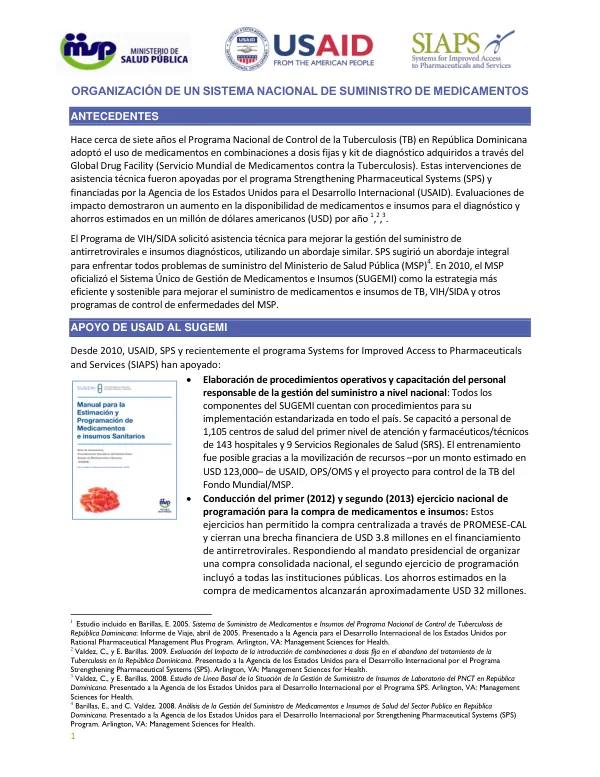
The Programa Nacional de Control de la Tuberculosis (TB) in the Dominican Republic adopted the use of fixed-dose combination medicines and diagnostic kits acquired through the Global Drug Facility in 2011, with technical assistance from the Strengthening Pharmaceutical Systems (SPS) program and funding from the United States Agency for International Development (USAID). Evaluations of the impact of this initiative demonstrated an increase in the availability of medicines and supplies, as well as estimated savings of $1 million per year. The Programa de VIH/SIDA requested technical assistance to improve the management of antiretroviral medicines and diagnostic supplies, using a similar approach. SPS suggested an integrated approach to address all supply chain problems faced by the Ministry of Public Health (MSP). In 2010, the MSP officially established the Sistema Único de Gestión de Medicamentos e Insumos (SUGEMI) as the most efficient and sustainable strategy to improve the supply of medicines and supplies for TB, HIV/AIDS, and other disease control programs. USAID, SPS, and the Systems for Improved Access to Pharmaceuticals and Services (SIAPS) program have provided support to SUGEMI since 2010, including the development of operational procedures and training of personnel responsible for supply chain management at the national level. All components of SUGEMI have standardized procedures for implementation nationwide, and training was provided to personnel at 1,105 health centers and 143 hospitals and 9 Regional Health Services (SRS). The training was made possible through the mobilization of resources estimated at $123,000 from USAID, the Pan American Health Organization (PAHO), and the Global Fund/TB project. The first (2012) and second (2013) national exercises for programming the purchase of medicines and supplies were conducted, allowing for centralized purchasing through PROMESE-CAL and closing a financial gap of $3.8 million in antiretroviral funding. The second exercise included all public institutions, and estimated savings in medicine purchases will reach approximately $32 million. A diagnostic study of regional warehouses and their fleet of transportation was conducted in 2010 and 2011, identifying financial requirements to improve storage and transportation conditions in SRS. Based on proposals for conditioning and construction, resources were mobilized nationally and internationally (from the Global Fund/TB project) for over $461,000 to initiate infrastructure improvement works. By July 2013, four regional warehouses – SRS II (Santiago), SRS III (San Francisco de Macorís), SRS VII (Valverde Mao), and SRS VIII (La Vega) – were readapted, and personnel were trained. A national inventory of medicines and supplies was conducted, marking the beginning of SUGEMI activities. According to the health sector reform, the inventory allowed for the transfer of medicines (731,078 units, valued at $115,749) from HIV and TB programs at provincial directions to SRS. An electronic application of the supply chain management information system was developed and installed, consolidating availability and consumption at regional and central levels. All personnel were trained in its operation. The first Diploma in Supply Chain Management was organized, with the purpose of contributing to the sustainability of SUGEMI. SPS developed educational modules for a certified course in supply chain management, which was imparted in collaboration with the national university (Universidad Autónoma de Santo Domingo, or UASD). The course was completed in May 2013 with the graduation of 33 students. USAID and its partners have achieved significant progress in implementing and consolidating SUGEMI, including the incorporation of regular operations funding into the MSP budget to ensure the sustainability of the system, the transfer of capacities to personnel at central and regional levels, the integration of disease control programs (PCE) into SUGEMI, and the analysis and discussion of results from national exercises for programming the purchase of medicines and supplies.