USAID DEC
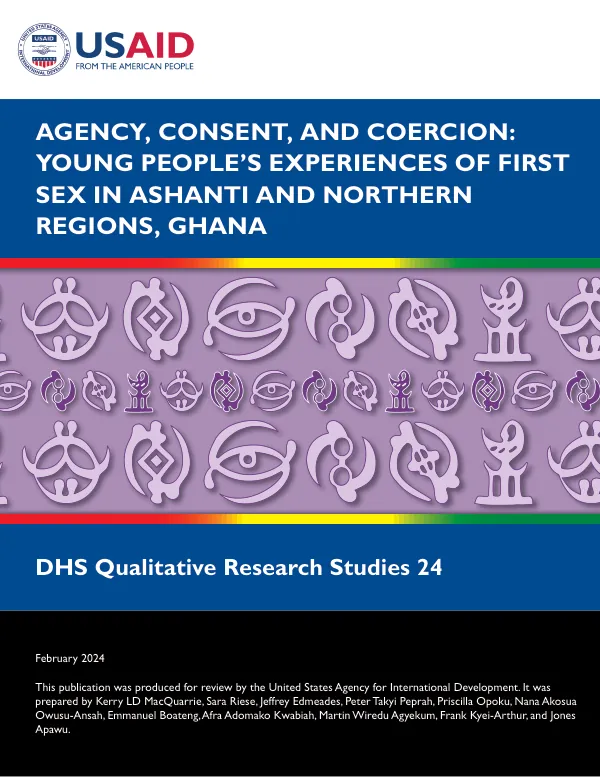
Overview - Agency, Consent, and Coercion: Young People's Experiences of First Sex in Ashanti and Northern Regions, Ghana (QRS24) - Analysis Brief [AB34]
Sign inICF
Overview - Agency, Consent, and Coercion: Young People's Experiences of First Sex in Ashanti and Northern Regions, Ghana (QRS24) - Analysis Brief [AB34]
Young people in Ghana are transitioning to adulthood and establishing romantic relationships, which often involve engaging in sexual activity for the first time.
2024 · 2 pages
Sign in to readA free account is required to download.
![Overview - Agency, Consent, and Coercion: Young People's Experiences of First Sex in Ashanti and Northern Regions, Ghana (QRS24) - Analysis Brief [AB34]](https://covers.devme.ai/gen/145280.webp)
Abstract
Despite increasing focus on adolescents and youth in family planning and reproductive health programming, little is known about their first sexual experience, particularly the context. Researchers and health programmers have limited knowledge about how young people make decisions at the time of first sex, experience coercion, or how coercive environments are created between couples. This qualitative study was conducted in the Ashanti and Northern regions of Ghana, where researchers identified eligible study participants through the 2022 Ghana DHS quantitative survey. Eligible participants were young women and men aged 15-29 who reported having first sex by age 18 (women) or age 20 (men), and whose first sex had occurred at least one year prior to the Ghana DHS interview. A total of 154 participants, including 114 young women and 40 young men, were interviewed using open-ended questions and a timeline activity. The study found that detailed and correct knowledge about sexual and reproductive health before first sex is very low among young people in Ghana. They lacked knowledge about basic topics, such as the risk of pregnancy at first sex or the possibility of bleeding at first sex. Young women often deferred to their partner regarding family planning, mistakenly assuming that he had more knowledge. Women, particularly in the Northern Region, were especially likely to report having insufficient knowledge to prevent unplanned pregnancy. The study also found that youth do not understand consent and sexual rights. Young people rarely discussed the concept of consent in their recollections of their first (or later) sexual experiences. Coercion at low or moderate levels is almost universal for women, and forced sex is fairly commonplace. Many young people reported that sex is a welcome event that they engaged in willingly, but a large number of young women reported that their first sexual experience was through rape, physical force, or threat of violence. The study highlights the importance of improving basic sexual and reproductive health knowledge among young people in Ghana. Strengthening existing programs that inform young people about sexual and reproductive health, including information about the risk of pregnancy at first sex and modern family planning options, is crucial. Health policy makers, program implementers, and instructors should not assume that all young people are abstaining from sex and should provide this knowledge before young people begin relationships, including marriage. The study also emphasizes the need to increase awareness and respect for sexual and reproductive health rights at the individual and collective levels. This includes educating young people about consent, the right to refuse to have sex, and clearly defining sexual coercion, including within marriage. Building young people's communication skills so they can effectively express themselves with their partners is also essential. Improving services available to young people who are victims of gender-based and sexual violence is critical, and continuing to change harmful gender norms in ways that empower all youth is necessary to improve adolescent health and wellbeing.
Related documents
Documents in this collection
![Relationship Context of First Sex - Agency, Consent, and Coercion: Young People's Experiences of First Sex in Ashanti and Northern Regions, Ghana (QRS24) - Analysis Brief [AB35]](https://covers.devme.ai/gen/145286.webp) 2024
2024USAID DEC
Relationship Context of First Sex - Agency, Consent, and Coercion: Young People's Experiences of First Sex in Ashanti and Northern Regions, Ghana (QRS24) - Analysis Brief [AB35]
Open record![Coercion at First Sex - Agency, Consent, and Coercion: Young People's Experiences of First Sex in Ashanti and Northern Regions, Ghana (QRS24) - Analysis Brief [AB38]](https://covers.devme.ai/gen/145287.webp) 2024
2024USAID DEC