USAID DEC
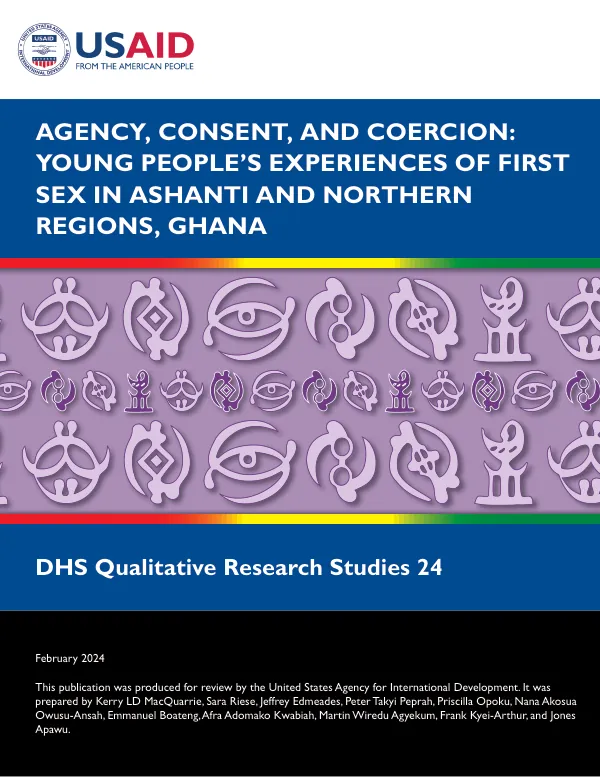
Agency, Consent, and Coercion: Young People's Experiences of First Sex in Ashanti and Northern Regions, Ghana
Sign inAVENIR HEALTH
Agency, Consent, and Coercion: Young People's Experiences of First Sex in Ashanti and Northern Regions, Ghana
The Ghanaian context is characterized by a high prevalence of early marriage and childbearing, with approximately 30% of girls marrying before the age of 18.
2024 · 171 pages
Sign in to readA free account is required to download.
Abstract
The country's population is predominantly rural, with limited access to education and healthcare services. In this context, young people's experiences of first sex are shaped by cultural, social, and economic factors. Research questions explored in this study include the relationship context of first sex, motivations for first sex, contraceptive use at first sex, and experiences of coercion at first sex. The study aimed to provide insights into the factors influencing young people's decisions and experiences surrounding their first sexual encounter. The study employed a qualitative research design, involving in-depth interviews with 120 young women and men aged 15-24 in the Ashanti and Northern Regions of Ghana. The sample selection was based on a stratified random sampling approach, with participants recruited from rural and urban areas. The study sites were selected to represent diverse cultural and socioeconomic contexts. The study instruments included a timeline activity, in-depth interview guide, and quantitative questions with computer-assisted personal interviewing (CAPI) capture. The timeline activity was used to gather information on participants' life events, including their first sexual experience. The in-depth interview guide explored participants' experiences and perceptions of first sex, relationships, and contraceptive use. The quantitative questions were used to gather additional information on participants' demographic characteristics and reproductive health behaviors. Data management involved transcription and coding of the interview data, using a thematic analysis approach. The analytical strategy involved identifying and categorizing themes and sub-themes related to the research questions. The profile of the analytical sample revealed that the majority of participants were female (63%), with a median age of 19 years. The relationship context of first sex was found to be complex and influenced by cultural, social, and economic factors. Participants reported that their first sexual experience was often initiated by their partner, with limited communication and negotiation around sex. Peers played a significant role in shaping participants' attitudes and behaviors around sex, with some participants reporting that their friends encouraged them to engage in sex. Motivations for first sex were diverse, with participants citing love, commitment, and pregnancy intention as key factors. However, some participants reported feeling pressured or coerced into sex, particularly in the context of early marriage or relationships. Contraceptive use at first sex was found to be low, with many participants reporting that they did not use contraception due to lack of knowledge, access, or autonomy in decision-making. Experiences of coercion at first sex were common, with participants reporting that they were forced or pressured into sex by their partner or family members. Coercion was often linked to power imbalances in relationships, with women and girls being more vulnerable to exploitation. The study highlights the need for targeted interventions to address the complex factors influencing young people's experiences of first sex, including education, healthcare, and social support services.
Related documents
Documents in this collection
![Relationship Context of First Sex - Agency, Consent, and Coercion: Young People's Experiences of First Sex in Ashanti and Northern Regions, Ghana (QRS24) - Analysis Brief [AB35]](https://covers.devme.ai/gen/145286.webp) 2024
2024USAID DEC
Relationship Context of First Sex - Agency, Consent, and Coercion: Young People's Experiences of First Sex in Ashanti and Northern Regions, Ghana (QRS24) - Analysis Brief [AB35]
Open record![Coercion at First Sex - Agency, Consent, and Coercion: Young People's Experiences of First Sex in Ashanti and Northern Regions, Ghana (QRS24) - Analysis Brief [AB38]](https://covers.devme.ai/gen/145287.webp) 2024
2024USAID DEC
![Overview - Agency, Consent, and Coercion: Young People's Experiences of First Sex in Ashanti and Northern Regions, Ghana (QRS24) - Analysis Brief [AB34]](https://covers.devme.ai/gen/145280.webp)