USAID. BUR. FOR AFRICA. OFC. OF SUSTAINABLE DEVELOPMENT
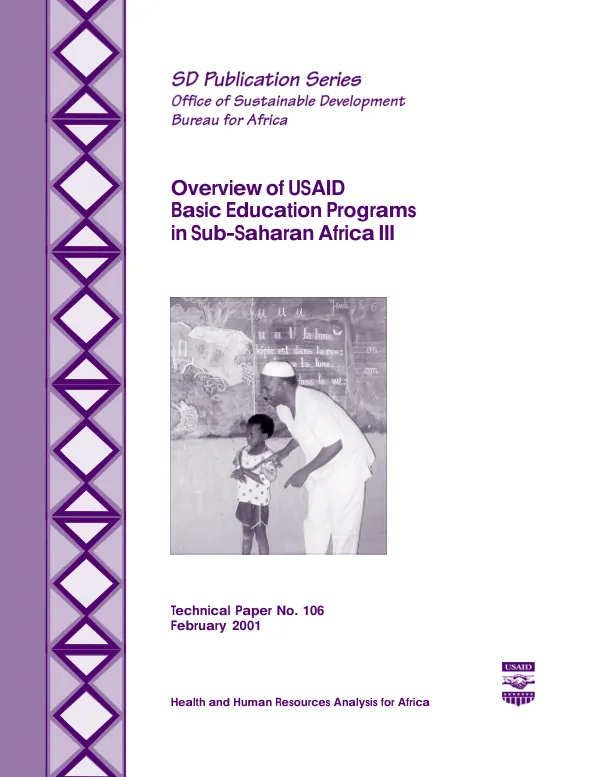
Overview of USAID basic education programs in Sub-Saharan Africa III
This report provides brief profiles of USAID"s basic education programs in 11 countries in sub-Saharan Africa: Ethiopia, Uganda, Zambia, Malawi, South Africa, Namibia, Benin, Ghana, Guinea, Mali, and Nigeria.
Freeman, Kay; Owen-Rea, Julie · 2001
Sign in to readA free account is required to download.
Abstract
For each program, the report provides background, the status of education reform in the country, USAID program activities, and other donors with education programs. An introduction sketches the genesis of USAID"s recent programs, which originated in a 1988 congressional setaside for education within the foreign assistance appropriation; USAID"s education sector support approach, which focuses on school and community change and systemic reform; and African ownership of, and capacity for, the reform process. The report also notes the common country-level characteristics addressed by the USAID program: (1) Many African countries have political boundaries that cut across ethnic groups. The dynamics among these groups determine the character of government institutions, including the school system. Other key forces include the country"s colonial history and its experience after independence. Many countries have preserved colonial practices that continue to impede progress. (2) African countries vary in terms of demographics, resources, and capacity to meet the health and education needs of their people. There are also notable differences in the status of the primary education system, i.e., enrollment, pupil-teacher ratios, and government expenditure on education. (3) USAID supports a nation"s education reform program. The nature and quality of the reform may vary from country to country in terms of goals, priorities, and the clarity of definition of and commitment to them; the technical quality of sectoral information and analysis; the participation leading to the reform; and the comprehensiveness and nature of proposed changes. These variations in the policy environment influence the progress and impact of the program. (4) USAID"s program varies both in modalities of assistance (project and non-project assistance [NPA], which is tied to conditionality); and implementation, e.g., use of institutional contractors for long-term assistance, cooperative agreements with local NGOs or the Peace Corps, indefinite quantity contracts (IQCs). Because both the Development Fund for Africa (DFA) legislation and NPA guidelines contain an explicit directive that program evaluations reflect people-level impacts, USAID"s support of education reform is ultimately accountable for outcomes such as increased enrollment, students progressing without repeating grades, and graduating with skills and behaviors conducive to life-long learning. Because these indicators change only years after system-wide reform has taken root, other indicators serve to mark improvements in the system, such as the ratio of pupils to teachers and the equitable access of girls and boys.