CULTIVATING NEW FRONTIERS IN AGRICULTURE
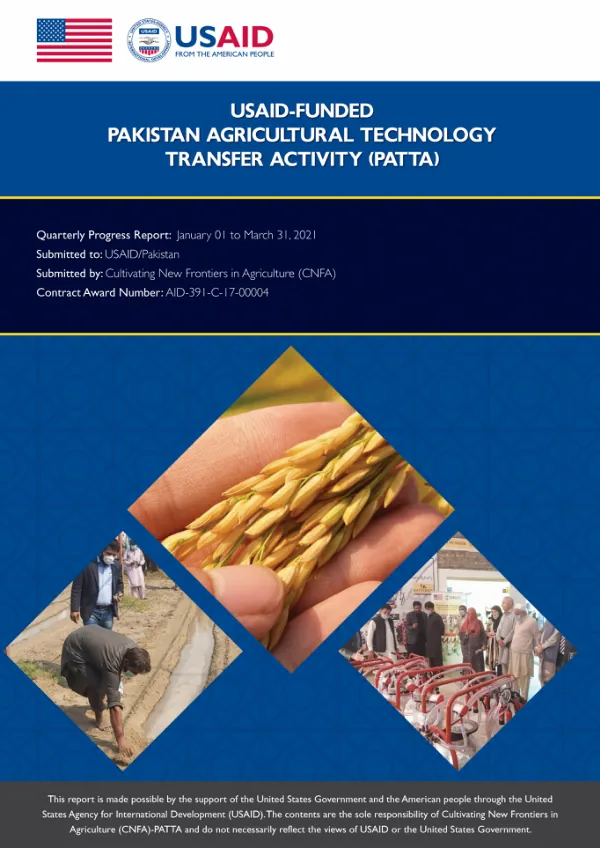
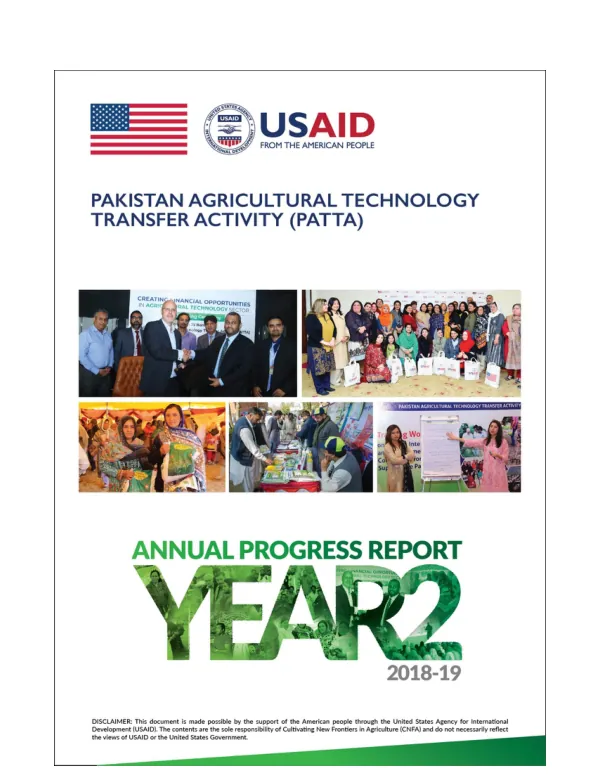
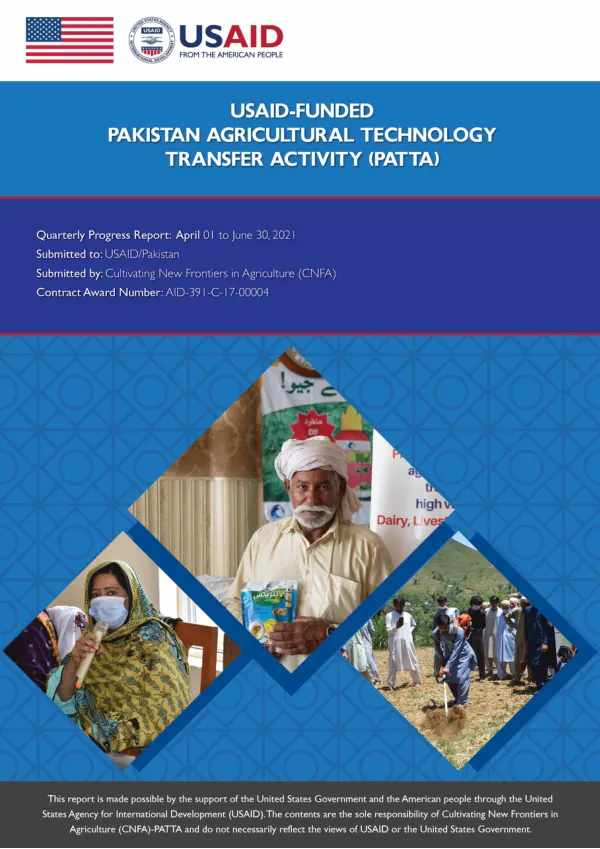
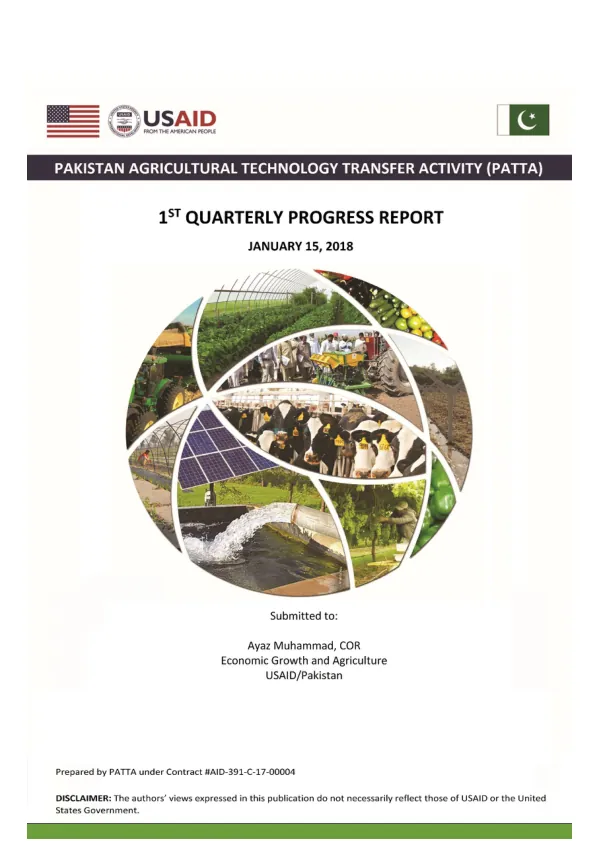
Pakistan Agricultural Technology Transfer Activity (PATTA)
The Pakistan Agricultural Technology Transfer Activity (PATTA) is a 4-year initiative funded by the United States Agency for International Development (USAID) to improve agricultural productivity in Pakistan.
2021 · 16 pages
Sign in to readA free account is required to download.
Abstract
PATTA aims to identify, support, and bring to scale private sector solutions to increase the productivity and competitiveness of smallholder farmers. The project will partner with agricultural technology companies to commercialize products and services that can increase productivity and access to markets, build resilience to climate change, and reduce post-harvest losses. PATTA's overall project goal is to increase smallholder farmers' incomes and access to employment opportunities by linking them to right-sized technology. The project objectives include enabling agricultural technology-related businesses to expand and adapt their products and services to meet smallholder farmers' needs, increasing smallholder farmers' access to affordable, appropriate, and effective agricultural technology, and scaling up the adoption and use of agricultural technologies. During the project life cycle, PATTA expects to leverage at least USD 4.8 million in private sector capital investment and create at least 3,400 jobs by 2021, benefitting over 100,000 farmers, 20% of whom will be women. The project aims to create a minimum of 2,500 jobs generated when smallholders transition from subsistence livelihood to commercial production. A minimum of 900 jobs are expected to be created when thirty technology firms and three hundred and fifty demand-side partners expand their workforces with support from PATTA's customized capacity building and technical assistance activities. The project will target the commercialization of at least five hundred tools, technologies, and practices and will engage at least 225,000 stakeholders, such as farmers, agro-dealers, input suppliers, and associations, in awareness-raising sessions. It is expected that at least 175,000 stakeholders will benefit by demonstrating knowledge of project-supported technologies, 122,500 farmers will use them, around 24,500 of whom will be women, and the value of their sales will reach USD 8.58 million. The project will launch and support a range of cross-cutting activities, including environmental stewardship, communications and public outreach, partnerships and linkages with key stakeholders, and other donor projects involved in similar initiatives. PATTA will partner with agricultural technology companies to commercialize products and services that can increase the productivity and competitiveness of smallholder farmers and mobilize private sector investment in agricultural technology. The project's start-up planning and execution involved mobilizing key personnel and technical staff, establishing relationships among implementing partners and key industry stakeholders, moving into a new office space, procurement of major equipment, facilitation of CNFA registration in Pakistan, and opening a new project bank account. The program submitted its key deliverables, including the mobilization plan, annual work plan, gender integration plan, sustainability plan, and Branding and Marking Plan. The PATTA start-up team developed a project pre-mobilization plan after the project was awarded and submitted it to the USAID. The start-up team held planning meetings with CNFA HQ and Field team in Islamabad to discuss project implementation and key activities. The project's start-up activities were characterized by a number of key milestones, including the mobilization of key personnel and technical staff, establishment of relationships among implementing partners and key industry stakeholders, and submission of key deliverables. The project's financial expenditure summary is not provided in this section, but it is expected to be discussed in a subsequent section. The project's monitoring and evaluation plan will be implemented to track progress and ensure that the project's objectives are met. The project's activities planned for the next quarter will focus on implementing key project activities and achieving project objectives. The project's security situation will be monitored to ensure the safety of project staff and stakeholders.