USAID DEC
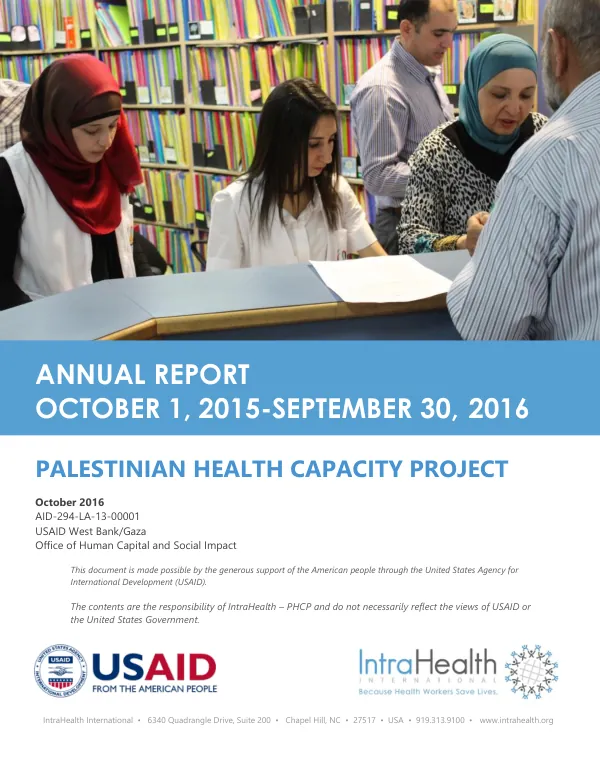
Palestinian Health Capacity Project Annual Report October 1, 2015-September 30, 2016
Sign inINTRAHEALTH
Palestinian Health Capacity Project Annual Report October 1, 2015-September 30, 2016
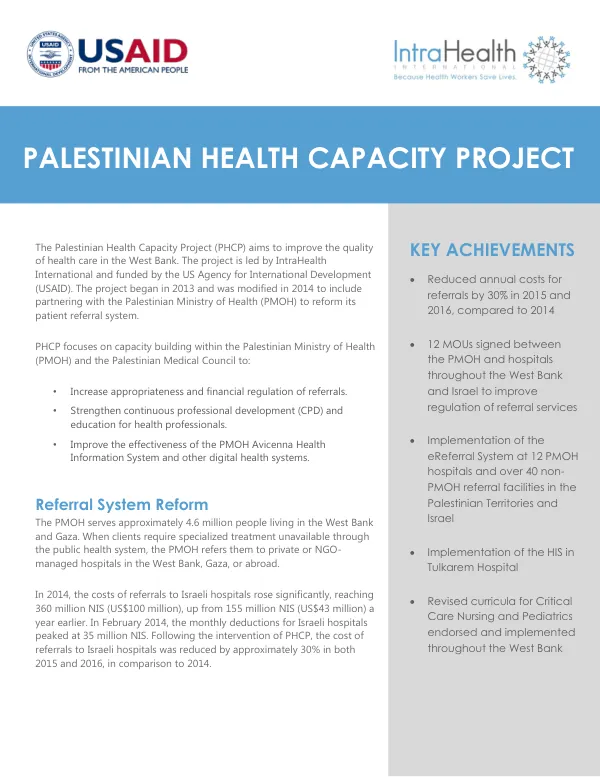
The Palestinian Health Capacity Project (PHCP) was awarded in March 2013 with the goal of improving the quality, efficiency, and effectiveness of healthcare in the West Bank.
2016 · 46 pages
Sign in to readA free account is required to download.
Abstract
The project's initial one-year work plan was submitted to USAID/WB and approved for the period March 4, 2013, to March 3, 2014. However, during the first few months of PHCP, a strong interest emerged from the Palestinian Ministry of Health (PMOH) and its partners, including USAID, in cutting down the number and cost of medical referrals outside the Palestinian PMOH facilities, especially to Israeli hospitals. As a result, PHCP adjusted its technical focus at the end of March 2014 to support the PMOH in better controlling referrals to Israeli hospitals. A sixth objective was added to the project towards the end of 2015 to strengthen and expand the existing PMOH Health Information System (HIS). The revised six PHCP objectives are: 1. Strengthen PMOH capacity to refine and manage effective systems to control referrals from secondary to tertiary care. 2. Strengthen the capacity of the PMOH to use data for improving health workforce planning and management of patient referrals within and outside the country. 3. Improve the governance structures and operating procedures within the PMOH Service Purchase Department (SPD) and throughout the whole referral system. 4. Improve pre-service (PSE) and in-service education (ISE). 5. Develop and implement a mechanism for licensing and certification of health workers. 6. Strengthen the capacity of the PMOH to collect, organize, maintain, and use electronic data to support the provision of quality health services. PHCP's approach focuses on local capacity building and technical assistance (TA) toward the goal of improving the quality, efficiency, and effectiveness of healthcare in the West Bank. In FY 2016, PHCP continued to build capacity within the PMOH at strategic and operational levels to improve referral mechanisms, processes, and procedures, strengthened planning, education, and professionalization of health worker cadres, and supported the development of robust health information systems. PHCP supported the Service Purchase Department (SPD) to revise and develop the SPD referral guidelines and referral procedures manual for non-PMOH Palestinian hospitals, which were approved by the PMOH and USAID. Additionally, a draft manual for referral procedures for Israeli hospitals was developed. These manuals clearly state the principles and conditions for referrals and the rules providers are to follow when delivering services to referred patients. PHCP also supported multiple meetings and workshops during FY16 to disseminate and introduce these manuals to the SPD, Referral Committees (RCs), and referral hospital staff. This dissemination helped ensure that healthcare workers involved in the referral processes are up to date on referral process improvements and aware of their responsibility in adhering to referral guidelines and operating procedures. Capacities of staff at SPD's various units, especially hospital coordinators and medical reviewers, have been strengthened through ongoing coaching and on-the-job support that will help ensure greater sustainability. PHCP and PMOH drafted three referral clinical protocols in oncology/hematology, ophthalmology, and cardiology, which are in the process of approval and finalization by PMOH stakeholders. The oncology/hematology protocol has been endorsed by the Deputy Minister. These protocols aim to improve the appropriateness and financial control of referrals, strengthen Continuous Professional Development (CPD) and residency programs, and strengthen the effectiveness of the Health Information System. PHCP continued to build capacity within the PMOH to improve referral mechanisms, processes, and procedures, strengthened planning, education, and professionalization of health worker cadres, and supported the development of robust health information systems. The project's focus on local capacity building and technical assistance has contributed to improving the quality, efficiency, and effectiveness of healthcare in the West Bank.
Related documents