INTRAHEALTH
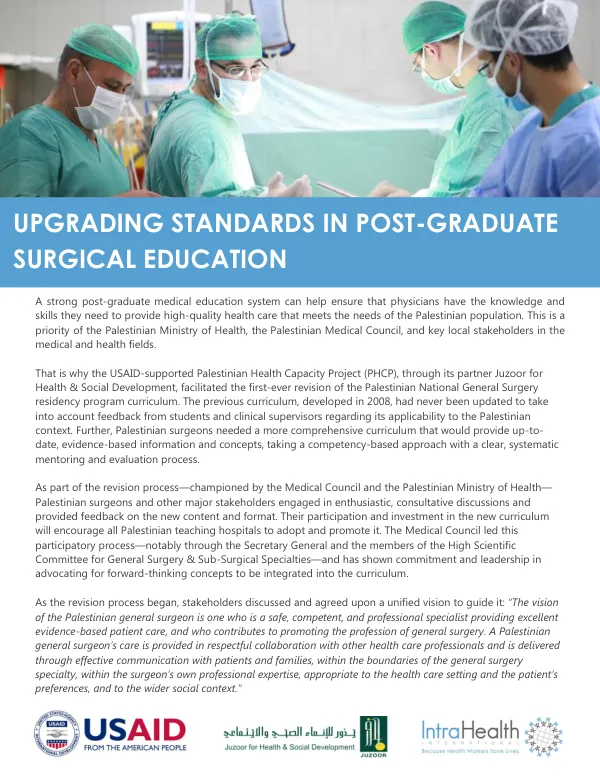
Upgrading Standards in Post-Graduate Surgical Education
The Palestinian National General Surgery residency program curriculum underwent a significant revision in 2023, facilitated by the USAID-supported Palestinian Health Capacity Project (PHCP) through its partner Juzoor for Health & Social Development.
2018 · 2 pages
Sign in to readA free account is required to download.
Abstract
The previous curriculum, developed in 2008, had not been updated to reflect feedback from students and clinical supervisors regarding its applicability to the Palestinian context. The revised curriculum aims to provide a more comprehensive and evidence-based education for Palestinian surgeons. The revision process involved enthusiastic and consultative discussions among Palestinian surgeons and other major stakeholders, who provided feedback on the new content and format. The Medical Council led this participatory process, demonstrating commitment and leadership in advocating for forward-thinking concepts to be integrated into the curriculum. A unified vision guided the revision process: "The vision of the Palestinian general surgeon is one who is a safe, competent, and professional specialist providing excellent evidence-based patient care, and who contributes to promoting the profession of general surgery." Local and international consultants drafted the revised curriculum based on this vision, with ongoing input from stakeholders. The resulting curriculum standardizes post-graduate general surgery medical education according to up-to-date, evidence-based knowledge and practices, and will ultimately improve the quality of surgical care. The curriculum is applicable and realistic in the Palestinian context and provides a detailed guide for learners' training across all years of the program. A unique feature of this curriculum is the introduction of a competency framework, adapted from international models, to serve as a basis for post-graduate medical education. The framework consists of six skills domains: surgical specialty, interpersonal and communication skills, teamwork and interprofessional collaboration, leadership promotion, teaching and learning, and professionalism and ethics. These skills domains emphasize nontechnical skills, which are part of the well-rounded education necessary to achieving the stakeholders' vision of the Palestinian surgeon. The revised curriculum is useful to everyone in the surgery residency program, including learners (residents), teachers (clinical instructors), administration and management (program directors), and the Medical Council, which will use it as a benchmark for educating future surgeons. The process by which the general surgery curriculum was revised serves as a model for revising other post-graduate medical sub-specialty curricula. Raising standards in medical and nursing education can raise the quality of health care, and PHCP implementing partners IntraHealth International and Juzoor look forward to continuing to support competency-based and evidence-based reviews of national health training curricula in priority areas.