DEMOCRACY INTERNATIONAL, INC.
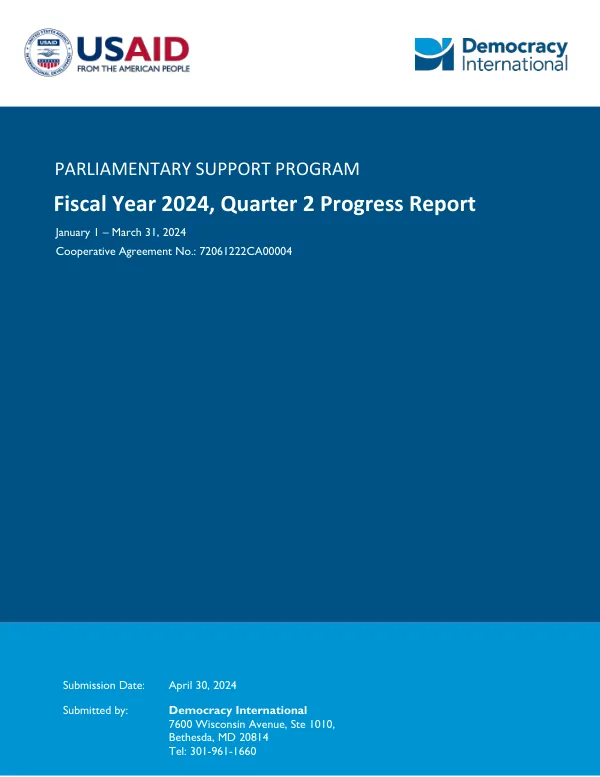
Parliamentary Support Program Fiscal Year 2024, Quarter 2 Progress Report
The Parliamentary Support Program in Malawi is a USAID-funded initiative aimed at strengthening the country's democratic governance by supporting the Parliament of Malawi to fulfill its legislative, oversight, and representative functions.
2024 · 37 pages
Sign in to readA free account is required to download.
Abstract
The program provides technical support to selected committees and caucuses, facilitates collaboration between Parliament and statutory oversight institutions, and integrates social and behavioral science research to identify key behaviors and barriers to reform. To implement the project, Democracy International has partnered with the Democracy Works Foundation, Global Partners Governance, and local organizations such as the Centre for Social Accountability and Transparency, the Institute of Public Opinion and Research, and Youth and Society. The program has been working with all project partners since the first quarter of 2024, expanding its activities across Malawi. During the reporting period of January 1 to March 31, 2024, the program implemented activities across its three purposes: improving the legislative and oversight roles of Parliament, strengthening institutional coordination for public integrity management, and improving civic engagement in policy and oversight processes. The program provided comprehensive assistance to the Parliament of Malawi to conduct substantive scrutiny of the proposed 2024/2025 national budget, seconding budget analysts to support eight committees and parliamentary staff. The program also worked with the Public Accounts Committee to initiate a post-legislative scrutiny process and continued developing the Speaker's Handbook, advancing the Code of Conduct, and facilitating the review of the Standing Orders. Additionally, the program engaged with Members of Parliament (MPs) and residents in Dowa West, Mangochi South, and Mchinji South, trained community leaders and MP support staff, and conducted field interviews for a national survey with over 3,000 households in 27 of the 28 districts across Malawi. The program achieved several key milestones during the reporting period, including improving the scrutiny and debate quality on the 2024/2025 national budget by eight parliamentary committees, surveying 3,166 individuals in 27 districts on perceptions of Parliament, and engaging 265 constituents in structured and constructive dialogues on local priorities. The program's activities are focused on improving the legislative and oversight roles of Parliament, strengthening institutional coordination for public integrity management, and improving civic engagement in policy and oversight processes. The program's key activities include supporting the implementation of the Parliament's Strategic Plan, reviewing the Standing Orders, and developing the Speaker's Handbook. The program's partnership with local organizations has been instrumental in expanding its activities across Malawi and engaging with various stakeholders, including Members of Parliament, residents, community leaders, and civil society activists. The program's work has contributed to the strengthening of Malawi's democratic governance and has the potential to have a lasting impact on the country's development. The program's progress has been monitored and evaluated through various indicators, including the number of parliamentary committees improving scrutiny and debate quality, the number of individuals surveyed on perceptions of Parliament, and the number of constituents engaged in structured and constructive dialogues on local priorities. The program's financial management has also been closely monitored, with a focus on ensuring that funds are used efficiently and effectively to achieve the program's objectives. Overall, the Parliamentary Support Program in Malawi has made significant progress in its first quarter of implementation, achieving several key milestones and expanding its activities across the country. The program's work has the potential to have a lasting impact on Malawi's democratic governance and development.
Related documents