USAID DEC
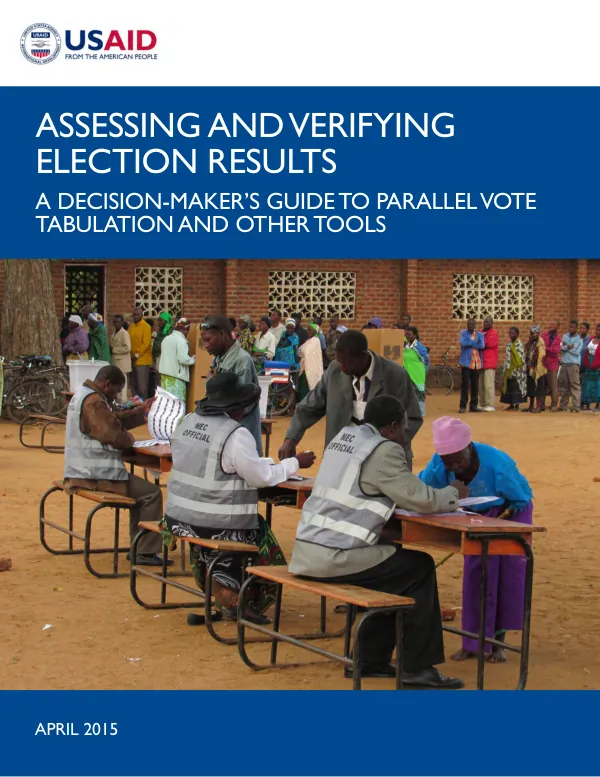
Assessing and Verifying Election Results: A Decision-Maker’s Guide to Parallel Vote Tabulation and Other Tools
Sign inDEMOCRACY INTERNATIONAL, INC.
Assessing and Verifying Election Results: A Decision-Maker’s Guide to Parallel Vote Tabulation and Other Tools
Election results assessment and verification are critical components of democratic processes.
2015 · 56 pages
Sign in to readA free account is required to download.
Abstract
Elections determine political winners and losers, and electoral processes have long been targeted for manipulation by unscrupulous regimes and actors. Such manipulation weakens public trust in democratic processes, erodes the legitimacy of governments, and undermines the will of the people. Suspicions of electoral fraud can catalyze polarization or trigger conflict. USAID and other donors work to build confidence in elections by improving the performance and accountability of electoral management bodies, strengthening meaningful and peaceful political competition, and supporting citizen oversight of electoral processes. Robust citizen oversight of elections is critical, as it can help deter and detect electoral malfeasance, engage citizens in democratic processes, and build trust in election outcomes. Free, competitive, and well-managed elections are essential to any democratic system. Despite being used with increasing frequency, election results assessment and verification efforts are often misunderstood. This guide provides USAID Democracy, Human Rights and Governance (DRG) officers, donors, and other development stakeholders with information on methodologies designed to assess or verify the credibility and legitimacy of election results. The guide focuses primarily on parallel vote tabulation (PVT) because it is the most widely used and, in most cases, the most definitive and effective results verification tool. PVTs are used to assess and verify election results by comparing the official results with the results obtained from a separate, independent count of the votes. This guide also includes exit polls and election forensics as tools that can be used in some contexts to help assess and understand election results. The guide provides specific guidance on when to support efforts to assess or verify election results, as well as when each tool is most useful in a given context. It also offers insights into when it may be more appropriate to focus limited resources in other ways and how to proactively design and manage these tools throughout the electoral cycle. This guide builds on previous work by the National Democratic Institute for International Affairs (NDI), Democracy International (DI), and others. It is designed to fill a gap in the literature by providing high-level background information on different tools for election results assessment and verification, a decision-making framework for determining whether and how to use these tools, and best practice guidance for managing PVTs. The guide has three sections: • Section One discusses the purposes of election results assessment and verification tools, introduces PVTs, exit polls, and election forensics, and writes about what these tools can do and their key considerations and challenges. • Section Two provides a step-by-step decision-making framework for determining whether assessing or verifying election results is feasible or appropriate in certain country contexts. This can help donors and implementers make informed judgments about what specific tools are likely to achieve, what risks they pose, and whether and how they should be implemented. • Section Three highlights some best practices for designing and managing PVTs from a donor's unique perspective. This includes understanding the requirements and misperceptions of sample-based tools for assessing and verifying election results, as well as the glossary of terms and endnotes. The guide is designed to be a practical resource for USAID DRG officers, donors, and other development stakeholders. It provides a comprehensive overview of the tools and methodologies used for election results assessment and verification, as well as a decision-making framework for determining whether and how to use these tools.