USAID DEC
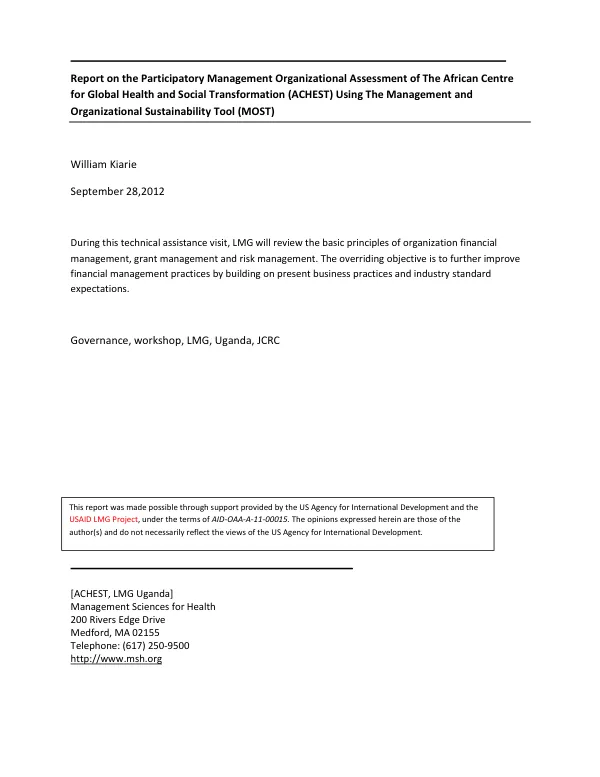
Participatory Management Organizational Assessment of The African Centre for Global Health and Social Transformation (ACHEST) Using The Management and Organizational Sustainability Tool (MOST)
Sign inGEORGE WASHINGTON UNIVERSITY CIBER
Participatory Management Organizational Assessment of The African Centre for Global Health and Social Transformation (ACHEST) Using The Management and Organizational Sustainability Tool (MOST)
The African Centre for Global Health and Social Transformation (ACHEST) is a not-for-profit organization based in Uganda.
2012 · 32 pages
Sign in to readA free account is required to download.
Abstract
The organization has a vision of "Africa as a people-driven continent enjoying the highest attainable standard of health and quality of life." ACHEST's mission is to promote evidence-based and technically sound policies and strategies that are owned and driven by African populations themselves. ACHEST's core strategy consists of forging alliances and partnerships with individuals and organizations within Africa and around the world, conducting policy and strategy-oriented research focused on Africa's engagement with global partners in health, economic, and social development, promoting and advocating for the development of capacity of African professionals and institutions to pursue excellence and engage as leaders and active change agents in their communities, countries, and in the global arena, and developing and implementing strategic communications with African and global leaders with targeted outcomes. The organization has 14 permanent employees and engages temporary staff as needed. ACHEST has four management organs: the Executive Board, Technical Advisory Board, Expert Panels and Networks, and the Secretariat. A Management and Organizational Sustainability (MOST) workshop was held at the Royal Suites Hotel in Kampala, Uganda on 19-21 September 2012. The workshop was part of the Leadership, Management, and Governance (LMG) project funded by USAID and implemented by a consortium of organizations, including Management Sciences for Health (MSH). Workshop participants included ACHEST staff and one Board Member as well as a representative from ACHEST partner George Washington University (GW). The MOST workshop aimed to assess ACHEST's management, governance, and organizational sustainability using the Management and Organizational Sustainability Tool (MOST). The workshop was facilitated by Mr. William Kiarie, MSH Consultant, and Mr. Paul Waibale, MSH-In-Country Senior Coordinator, with technical support and oversight provided by Mr. Alain Joyal, MSH Country Portfolio Director, and Ms. Sara Weinstein, MSH Senior Program Officer. The workshop involved individual and group assessments of ACHEST management, governance, and organizational sustainability, consensus on assessment scores, development and prioritization of actionable objectives, development of action plans, team building activities, and discussions on the way forward and next steps. Key findings from the workshop included areas of strength, such as the organization's vision and mission, and areas requiring improvement, such as financial management and grant management. Proposed objectives to improve organizational management and sustainability included prioritizing objectives, selecting objectives, and developing action plans. The workshop also included team building activities, discussions on the way forward and next steps, and a review of the workshop's expectations, output from the team building session, and evaluation. The workshop was evaluated using a workshop evaluation form, and detailed evaluation results were also provided. The MOST assessment was carried out by ACHEST staff and Management Sciences for Health (MSH) staff and consultants. The assessment aimed to provide a comprehensive understanding of ACHEST's management, governance, and organizational sustainability and to identify areas for improvement. The assessment results will inform the development of action plans to improve ACHEST's management and sustainability. The workshop was funded by the United States Agency for International Development (USAID) under Cooperative Agreement AID-OAA-A-11-00015. The contents of the report are the responsibility of the Leadership, Management, and Governance Project and do not necessarily reflect the views of USAID or the United States Government.