USAID DEC
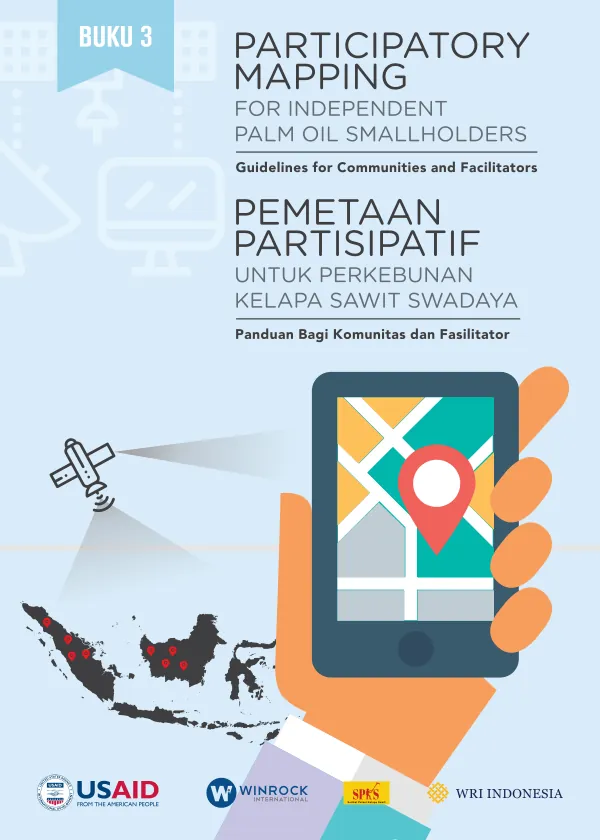
Participatory Mapping for Independent Palm Oil Smallholders Guidelines for Communities and Facilitators
Sign inWINROCK INTERNATIONAL FOUNDATION
Participatory Mapping for Independent Palm Oil Smallholders Guidelines for Communities and Facilitators
Participatory Mapping for Independent Palm Oil Smallholders is a crucial initiative aimed at empowering small-scale farmers to take control of their land and improve their socio-economic conditions.
2018 · 78 pages
Sign in to readA free account is required to download.
Abstract
The guidelines for communities and facilitators were developed by Winrock International, the Smallholder Union (SPKS), and WRI Indonesia, with funding provided by USAID through the Sustainable Palm Oil (ASLI) project. The importance of mapping for independent palm oil smallholders cannot be overstated. At present, the area cultivated by independent palm oil smallholders in Indonesia reaches 4.7 million hectares, accounting for approximately 41% of all oil palm plantations. However, this high level of production has not led to an increase in the standard of living of small-scale farmers in general. Independent palm oil smallholders still face numerous challenges, including land legality issues, low productivity, and limited access to financing sources. To address these issues, mapping the land and collecting socio-economic data of smallholders is essential. This will enable decision-makers to make informed decisions and minimize conflicts between parties. The guidelines aim to provide a comprehensive understanding of participatory mapping for independent palm oil smallholders, including the benefits of mapping, the importance of a participatory approach, and the minimum standard of landowner participation. The participatory mapping process involves the active involvement of relevant stakeholders within the community or village. This approach is essential, as independent palm oil smallholders have varying plantation sizes and land ownership, making it challenging to map their land accurately. Participatory mapping can overcome these limitations and ensure that the mapping process is accurate and detailed. The guidelines consist of seven chapters, each addressing a specific aspect of participatory mapping. Chapter 1 introduces the concept of participatory mapping and its importance for independent palm oil smallholders. Chapter 2 explains the benefits of mapping for smallholders, including improved land legality, increased productivity, and better access to financing sources. Chapter 3 highlights the importance of a participatory approach in mapping, emphasizing the need for landowner participation and the involvement of relevant stakeholders. Chapter 4 presents the technical concept of mapping, including the definition of a map, map scale, and data sources. Chapter 5 discusses the pre-conditions and preparation for participatory mapping, including determining the needs and purposes of mapping, sketching the mapping location, and forming an implementation team. Chapter 6 provides a detailed description of the mapping implementation, including the development of a work map, data acquisition, and environmental sustainability and safety considerations. Chapter 7 addresses the presentation and data management, including printed map presentation, map legalization, and map storage, as well as the establishment of a data management unit at the village level. The guidelines are designed to assist smallholder communities, facilitators, and village counselors in understanding the benefits of mapping and the importance of a participatory approach. By following these guidelines, smallholders can take control of their land and improve their socio-economic conditions, ultimately contributing to the sustainable development of the palm oil industry in Indonesia. The guidelines are based on the experiences and lessons learned from the participatory mapping trials conducted in several villages in Rokan Hulu, Riau, and Siak, Indonesia. The trials involved the active involvement of local villagers, facilitators, and stakeholders, and demonstrated the effectiveness of participatory mapping in improving the accuracy and detail of land mapping. In conclusion, the Participatory Mapping for Independent Palm Oil Smallholders guidelines provide a comprehensive framework for communities and facilitators to understand the importance of mapping and the benefits of a participatory approach. By following these guidelines, smallholders can take control of their land and improve their socio-economic conditions, ultimately contributing to the sustainable development of the palm oil industry in Indonesia.