FOOD AND AGRICULTURAL ORGANIZATION
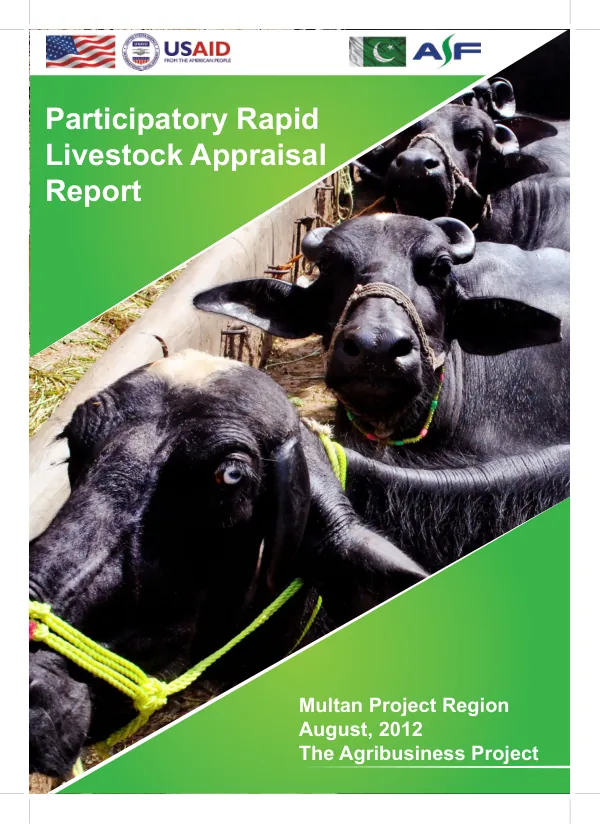
Participatory Rapid Livestock Appraisal Report of Multan Project Region
The Agribusiness Project, funded by USAID Pakistan, is being implemented by the Agribusiness Support Fund (ASF) in collaboration with international and national partner organizations.
2012 · 32 pages
Sign in to readA free account is required to download.
Abstract
The project aims to increase the competitiveness and productivity of the horticulture and livestock sub-sectors in Pakistan. The overall goal of the project is to support improved conditions for broad-based economic growth, create employment opportunities, and contribute to poverty alleviation through the increase in competitiveness of horticulture and livestock value chains in partnership with all stakeholders. The project commenced on November 10, 2011, and is scheduled to run for five years. During the first year, a preparatory program was undertaken to gauge the potential of the sub-sector and to prioritize value chains for various project regions, including the Multan Project region. The Multan region covers seven districts, including Multan, Sargodha, Toba Tek Singh, Chiniot, Mandi Bhauddin, Khushab, and Jhang. A two-pronged approach was adopted for the Participatory Rapid Livestock Appraisal (PRLA) exercise, which includes preparation for the exercise in the field and collection of secondary data and development of appropriate tools for quantification of factors to be measured on a scale for ranking/prioritization. The PRLA methodology provides for probing, analysis, and validation of information as they unfold during the field work. Seven factors were applied for the quick analysis of the sub-sector, including the extent of employment generation, commercial worth, percentage of small farmers associated, women involvement, households associated with the value chains, understanding growth potential, and vulnerability of the concerned value chains. The exercise was undertaken in 50% of the districts, covering randomly selected settlements/villages within each cluster/region. Each focus group consisted of 10-15 stakeholders, a representative sample of the sub-sector, and 2-3 Focused Group Discussions (FGDs) were carried out in each district. Prior to the primary data analysis, an appraisal of the livestock subsectors was conducted based on secondary data available to develop objective criteria for the prioritization of the subsectors within livestock milk, meat, byproducts, and fisheries value chains. The indicators used for analysis included growth of the subsector, employment generation, commercial worth, small farmer involvement, women involvement, household involvement, growth potential, and vulnerability. The analysis revealed that the livestock subsector in the Multan region has significant potential for growth and development. The region has a large livestock population, with a significant number of small farmers and households involved in the value chains. The PRLA exercise identified several opportunities and constraints in the livestock value chains, including the need for improved market linkages, better access to credit and finance, and enhanced business development services. The exercise also highlighted the importance of women's involvement in the value chains and the need to address the vulnerability of the concerned value chains. The findings from the PRLA exercise will enable the project to identify and prioritize livestock value chains, opportunities, constraints, and state of the business development services, providing a required basis for focusing project interventions. The project will work with stakeholders to address the identified opportunities and constraints, with the ultimate goal of improving the competitiveness and productivity of the livestock sub-sector in the Multan region. The livestock population in the Multan region is significant, with a large number of small farmers and households involved in the value chains. The region has a strong potential for growth and development, with opportunities for improved market linkages, better access to credit and finance, and enhanced business development services. The project will work to address the identified opportunities and constraints, with the ultimate goal of improving the competitiveness and productivity of the livestock sub-sector in the Multan region. The project will work with stakeholders to address the identified opportunities and constraints, with the ultimate goal of improving the competitiveness and productivity of the livestock sub-sector in the Multan region. The project will focus on improving market linkages, enhancing business development services, and addressing the vulnerability of the concerned value chains. The project will also work to enhance women's involvement in the value chains and improve access to credit and finance for small farmers and households.