USAID
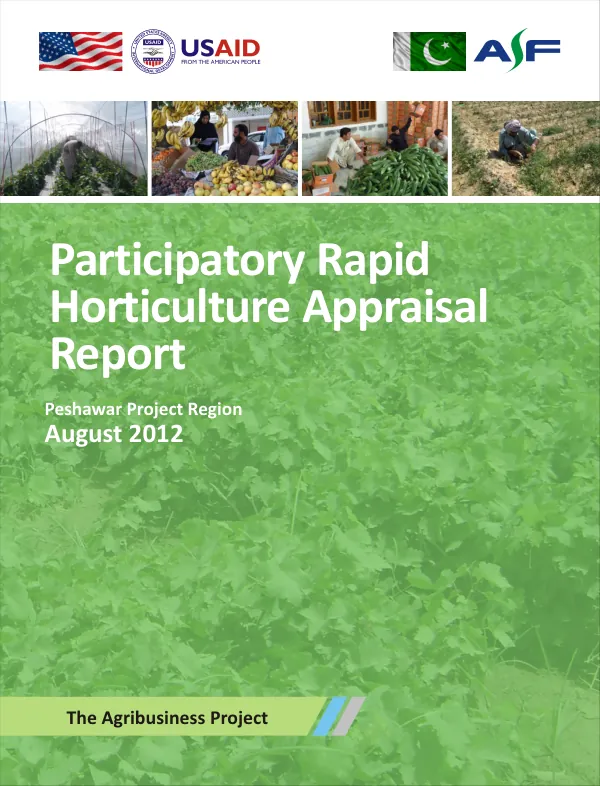
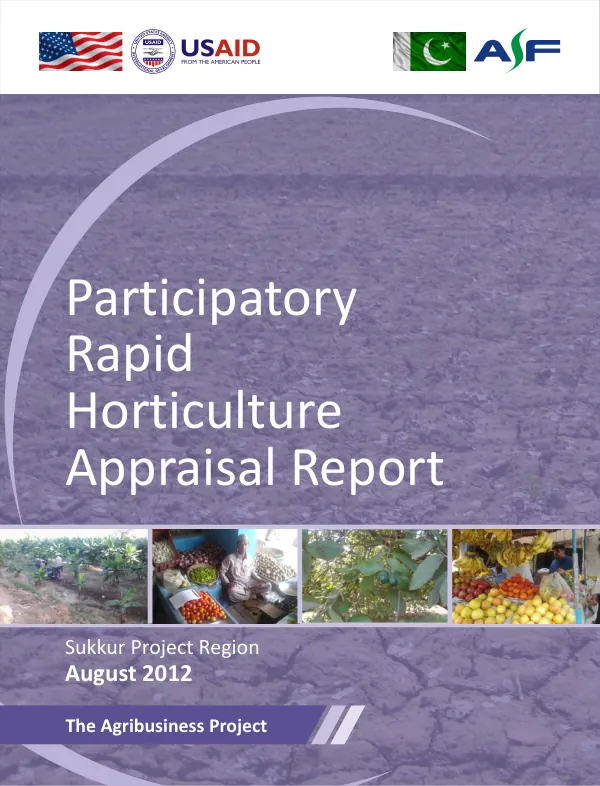
Participatory Rapid Horticulture Appraisal Report of Sukkur Project Region
The Agribusiness Project is an initiative funded by the United States Agency for International Development (USAID) and implemented by the Agribusiness Support Fund (ASF) in collaboration with international and national organizations.
2012 · 29 pages
Sign in to readA free account is required to download.
Abstract
The project aims to support improved conditions for broad-based economic growth, create employment opportunities, and contribute to poverty alleviation through the increase in competitiveness of horticulture and livestock value chains in partnership with all stakeholders. The project's overall goal is to strengthen the capacity in horticulture and livestock value chains to increase sales to domestic and foreign markets. Specific objectives include strengthening the capacity of smallholders and farmer enterprises to operate autonomously and effectively, and increasing agriculture efficiency and productivity through the adoption of new farming techniques and technological innovation among targeted beneficiaries. The project's preparatory program, launched during the first year, aimed to gauge the potential of the sub-sector and prioritize value chains in the context of various project regions, including the Sukkur Project Region. The Participatory Rapid Horticulture Appraisal (PRHA) methodology was applied to probe, analyze, and validate information as it unfolded during field work. Seven factors were applied in the prioritization of value chains, including the extent of employment generation, commercial worth, percentage of small farmers associated, women involvement, households associated with the value chains, understanding growth potential, and vulnerability of the concerned value chains. The analysis of secondary data is based on district-wise data on area and production for the last ten years, which was collected and tabulated as time series data. The PRHA exercise was undertaken in 50% of the districts, covering a randomly selected set of settlements and villages within each cluster or district. Each focus group consisted of 10-15 stakeholders, representing a representative sample of the sub-sector. In each district, 2-3 Focused Group Discussions (FGDs) were carried out. Based on the analysis of both secondary and primary information, guava, dates, onion, banana, and tomato are identified as priority value chains in the Sukkur Project Region. Guava is produced in large quantities in District Larkana and Noushero Feroze, with a 20% increase in growth recorded over the past five years. Dates are grown in District Khairpur in great quantity, with some reports indicating it has the highest dates-producing zone in South-east Asia. A number of opportunities exist in the region to catalyze the development of the sub-sector, including the availability of cold storage and market infrastructure, increasing demand in the national market, technological innovation, solar drying technology, support from the private sector, and financial support in the form of grants or interest-free loans. However, several constraints hamper the development of the fruit sub-sector, including limited knowledge about latest techniques, little knowledge about market intelligence, non-availability of certified seeds, non-availability of soft loaning facilities, particularly for tenants, poor packaging, improper food processing facilities, poor market linkages, and poor transportation systems. In the vegetable sub-sector, District Ghotki has a huge vegetable market and supplies vegetables to large markets in Sindh and Punjab. Vegetables are mostly grown for commercial purposes and some are also utilized domestically by producers. Major priority opportunities in the vegetable sub-sector include the availability of cold storage infrastructure, increasing market demand, market intelligence systems, potential for processing/preservation and export, and the introduction of tunnel technology. However, several constraints affect the vegetable sub-sector, including high prices of agricultural inputs, limited awareness among farmers about latest techniques, poor packing facilities and skills, no proper packing facilities, and poor quality seeds. The availability and quality of business development services are also important for the overall development of any sub-sector, and there is a need to build confidence and develop strong linkages of agribusiness with service providers.