ABT ASSOCIATES
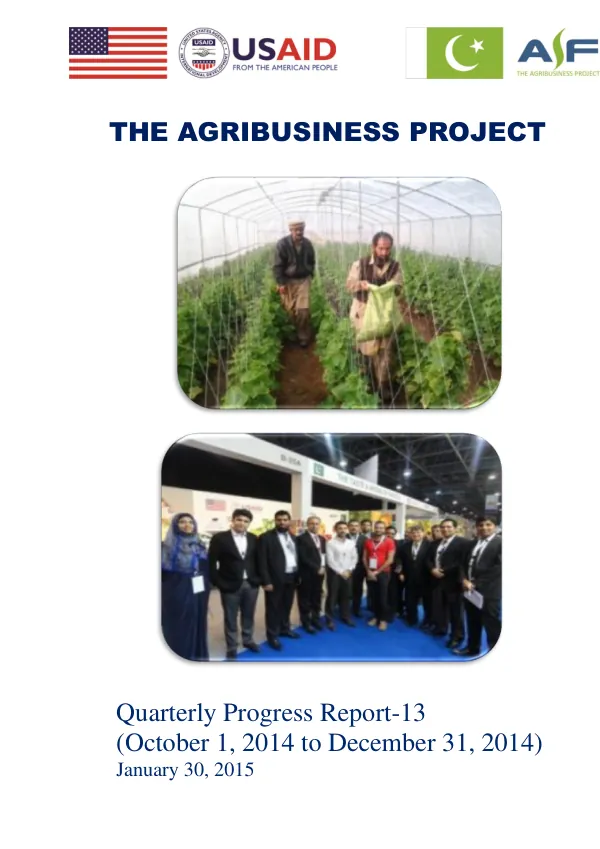
USAID’s Agribusiness Project–Quarterly Progress Report-13
The Agribusiness Project, funded by USAID, commenced on November 10, 2011, with the overall goal of increasing the competitiveness and productivity of horticulture and livestock sub-sectors in collaboration with all stakeholders.
2015 · 25 pages
Sign in to readA free account is required to download.
Abstract
The project is being implemented in collaboration with international and national partners. During the reporting quarter, October 1, 2014, to December 31, 2014, the project provided continued support to beneficiaries for establishment of vineyards, high tunnels for HV/OSV production, small solar dryers, provision of drying materials, and seed potato toolkits, through technical assistance, trainings, and transformational grant support. Key achievements during the quarter include: Under the international market access program, the project supported participation of eight exporting companies in two international exhibitions for fruit, vegetables, and meat, namely FoodEx Saudi and World Food Kazakhstan. The international STTAs developed marketing and branding strategies for horticulture and meat value chains, in consultative workshops with stakeholders in Lahore, Karachi, and Islamabad. Technical assistance and trainings were provided in the following areas: enterprise development, pre and post-harvest practices, integrated pest management, and artificial insemination technicians' trainings. A four-day exposure visit for 35 vegetable farmers from Malakand Division-KPK to commercial vegetable farms, markets, and retail chains in Gujranwala, Daska, Islamabad, Peshawar, and Charsadda was conducted to develop their market linkages. Eleven Farmer Field Days in KPK and Punjab, attended by 315 participants, including beneficiaries of high tunnels and representatives of farm services centers, extension, and research, service providers, and inputs suppliers, were conducted. Consultative workshops were conducted at Lahore and Islamabad with 29 stakeholders from the meat industry. The project obtained stakeholders' insight on feedlot fattening operations for development of a manual on feedlot fattening for the first time in Pakistan. During the reporting quarter, two of the value chains, Apricot and Chili, showed that project activities have had a major impact and started showing excellent results for the beneficiaries' businesses. The sales revenue of chili farmers increased by 46% due to improved practices leading to better quality of product. The incremental sales revenue touched USD 1.1 million, while profit margins increased by over 100%, creating 603 new jobs (50% female). Incremental sale revenue for apricot and additional assorted fruit/vegetables dried worth USD 130,200 was calculated; change in beneficiary income was recorded at USD 129,400, resulting in creation of 62 new jobs. The following key results against mission strategic framework indicators have been achieved: 1,148 new full-time equivalent jobs were created as a result of project activities implemented in apricot, chili, grapes, HV/OSV, and seed potato value chains and IMAP export facilitation. During the reporting period, 17 companies reported export of fruit, vegetables, and meat products worth USD 3.3 million to various export destinations, through participation in various IMAP events. USD 1.81 million private sector capital was leveraged, as a result of participation in project activities. Project-supported agribusinesses achieved cumulative incremental sales of USD 4.71 million. A total of 2,511 micro & small enterprises received business development services from USG-assisted resources; 1,099 enterprises were linked to larger-scale firms for input supplies and marketing, whereas 3,710 entities have reportedly applied new technologies and/or management practices. The project benefitted 2,498 rural households directly. A total of 1,589 hectares of land was brought under improved technologies and/or management practices. 20% female beneficiaries were included in various project activities during the reporting quarter. The project's goal is to increase the competitiveness and productivity of horticulture and livestock sub-sectors in collaboration with all stakeholders. The project is being implemented in collaboration with international and national partners. The project's components include technical assistance for value chain support, value chain transformation support, and financial support. The project has achieved significant progress in various areas, including market access and linkages, technical and managerial training, and value chain development. The project has supported the establishment of vineyards, high tunnels for HV/OSV production, small solar dryers, provision of drying materials, and seed potato toolkits, through technical assistance, trainings, and transformational grant support. The project has also provided business development services to micro and small enterprises, linked them to larger-scale firms for input supplies and marketing, and supported the application of new technologies and/or management practices. The project has achieved significant results, including the creation of 1,148 new full-time equivalent jobs, export of fruit, vegetables, and meat products worth USD 3.3 million, and cumulative incremental sales of USD 4.71 million. The project has also benefitted 2,498 rural households directly and brought 1,589 hectares of land under improved technologies and/or management practices. The project has included 20% female beneficiaries