USAID DEC
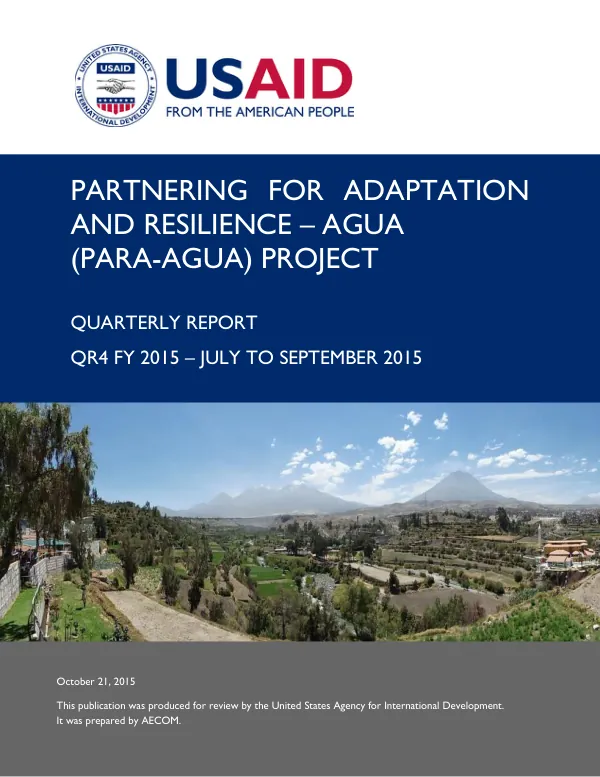
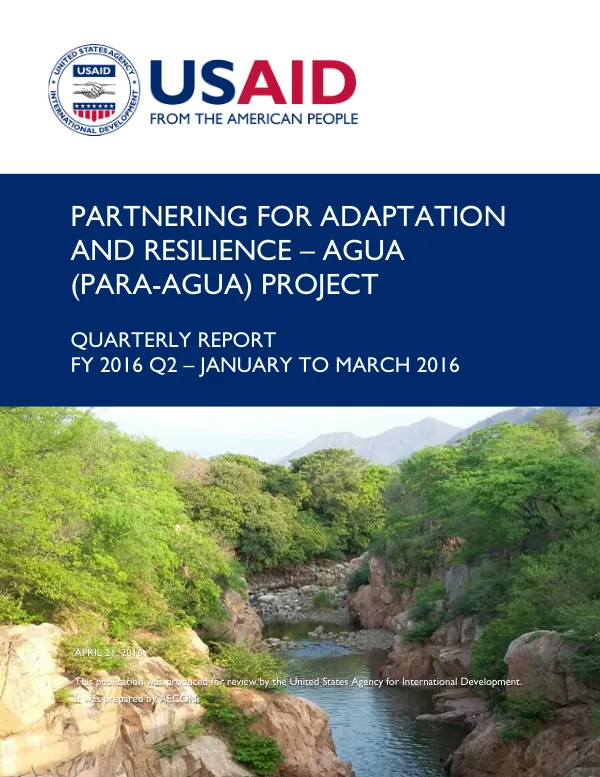
Partnering for Adaptation and Resilience – Agua (PARA-Agua) Project Quarterly Report FY 2016 Q2 – January to March 2016
Sign inUSAID
Partnering for Adaptation and Resilience – Agua (PARA-Agua) Project Quarterly Report FY 2016 Q2 – January to March 2016
The Partnering for Adaptation and Resilience – Agua (PARA-Agua) project is a four-year climate change adaptation and policy initiative funded by the United States Agency for International Development (USAID).
2016 · 32 pages
Sign in to readA free account is required to download.
Abstract
The project focuses on five watersheds throughout Peru and Colombia, with activities in two target watersheds, the Chira-Piura Watershed in northern Peru and the Chinchina Watershed in Colombia, since 2013. The project aims to strengthen watershed resilience to climate change by working directly with scientists, decision-makers, and communities. During the second quarter of 2016, project activities accelerated as PARA-Agua aligned itself fully to its work plan and launched activities throughout the region. These activities linked scientific approaches and new data to decision-making, bringing together regional officials, local water resource managers, and technical staff eager to learn and share. PARA-Agua continues to communicate best practices and interact with its partners in the region through its online Community of Practice (CoP), which hosted two webinars and successfully drew in audiences from across the region. The project facilitated two productive exchanges that strengthened the project's twinning partnerships. In January, stakeholders from the Chira-Piura and Quilca-Chili Watersheds met with respective counterparts in Loja, Ecuador to exchange experiences regarding the establishment of water funds. Later that same month, PARA-Agua stakeholders from the Chira-Piura and Chinchina Watersheds traveled to Sonoma and Yolo counties in California for an intensive week of exchanges and learning opportunities with American water agencies. In March, the project hosted a full-day exchange forum in Lima, attracting more than 70 participants, including government officials, regional representatives, and key actors from public and private sectors from Peru, Colombia, and the region. This event generated vigorous discussion on specific initiatives to increase collaboration between research and policy makers, and to improve planning at the sub-national and national levels in the face of climate change. PARA-Agua also continued to implement initiatives outlined and prioritized in the project's Gender Action Plan. The team has built on the project's success pushing forward the project's gender activities, calling attention to the linkages between gender and climate change, and highlighting PARA-Agua's commitment in showcasing gender concerns not as a special or separate interest, but as an integral theme to the work being done in the climate change space. In Colombia, the project produced five short videos profiling women and women's organizations working in conservation, research, and advocacy in the Chinchina Watershed. In Peru, the Ministry of Environment (MINAM) released the final version of the national Plan de Acción de Género y Cambio Climático, the Gender Action Plan for Climate Change in English, (PAGCC Peru) which was directly influenced by the results from PARA-Agua Gender Analyses in the watersheds. The project's overall goals and objectives include strengthening the ability of up to four key glacier, snow, and ice research centers in the region to generate policy-oriented scientific data on high montane hydrological systems, ensuring that new climate data is integrated regularly into decision-making processes, and supporting the development of climate-resilient water management practices in the region. The project has a total funding of USD 7,995,163.82 and is expected to continue until September 8, 2017.