FHI 360
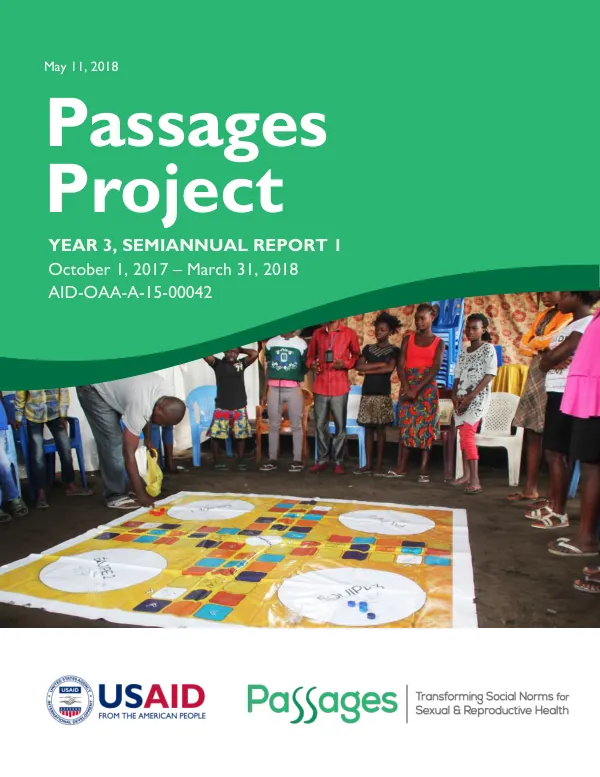
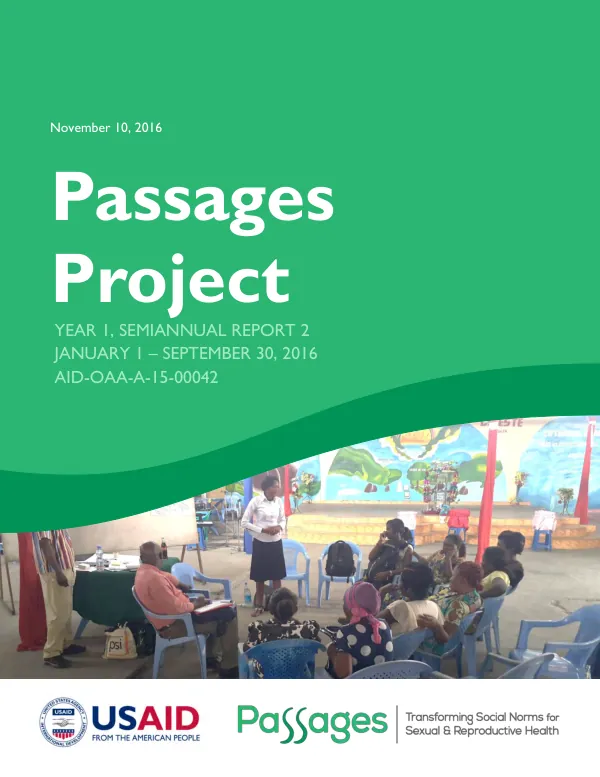
Passages Project Year 1, Semiannual Report 2, January-September, 2016
The Passages Project is a global initiative aimed at improving adolescent and youth sexual and reproductive health (AYSRH) outcomes.
2016 · 37 pages
Sign in to readA free account is required to download.
Abstract
The project began in 2015 with funding from the United States Agency for International Development (USAID) under Cooperative Agreement No. AID-OAA-A-15-00042. The project is implemented by the Institute for Reproductive Health at Georgetown University in collaboration with several partners, including FHI 360, JHSPH/GEAS, PSI, Save the Children, and Tearfund. The project's main purpose is to generate evidence on effective mechanisms and programs to develop normative environments that support positive AYSRH outcomes. To achieve this goal, the project is divided into three intermediate results (IRs): IR 1, IR 2, and IR 3. IR 1 focuses on piloting and testing scalable interventions to generate evidence on effective mechanisms and programs. IR 2 involves assessing interventions and building local capacity to plan and implement scale-up. IR 3 focuses on global leadership, including knowledge management, research utilization coordination, and stakeholder analysis. The project's implementation is coordinated through a project management and coordination framework, which includes regular meetings with partners, USAID, and the Democratic Republic of Congo (DRC) government. The project also has a monitoring and evaluation (M&E) system in place, which includes M&E management, M&E systems development, and an M&E working group. The project's M&E framework is designed to track progress towards the project's intermediate results and to identify areas for improvement. One of the key interventions being piloted and tested under IR 1 is the Masculinité, Famille, et Foi (MFF) program, which aims to promote positive masculinity and family planning behaviors among adolescent boys in the DRC. The program has been replicated and tested in new settings, including the Growing Up GREAT! (GUG!) program, which aims to promote positive gender roles and equality among adolescent girls in the DRC. The project's research and evaluation activities are designed to assess the effectiveness of these interventions and to identify areas for scale-up. The project's research findings are being disseminated through various channels, including publications, presentations, and stakeholder meetings. The project's global leadership activities are focused on building capacity among partners and stakeholders to plan and implement scale-up of effective interventions. The project's priority activities for year 2 include continuing the implementation of IR 1 and IR 2, as well as scaling up effective interventions and building local capacity to plan and implement scale-up. The project's M&E framework will continue to track progress towards the project's intermediate results and to identify areas for improvement. The project's global leadership activities will focus on building capacity among partners and stakeholders to plan and implement scale-up of effective interventions. The project's geographic focus is on the Democratic Republic of Congo, with a particular emphasis on improving AYSRH outcomes among adolescent girls and boys. The project's timeframes are from 2015 to 2020, with a focus on year 2 activities. The project's recommendations for scale-up and replication of effective interventions will be based on the research and evaluation findings, as well as stakeholder feedback and input.