USAID DEC
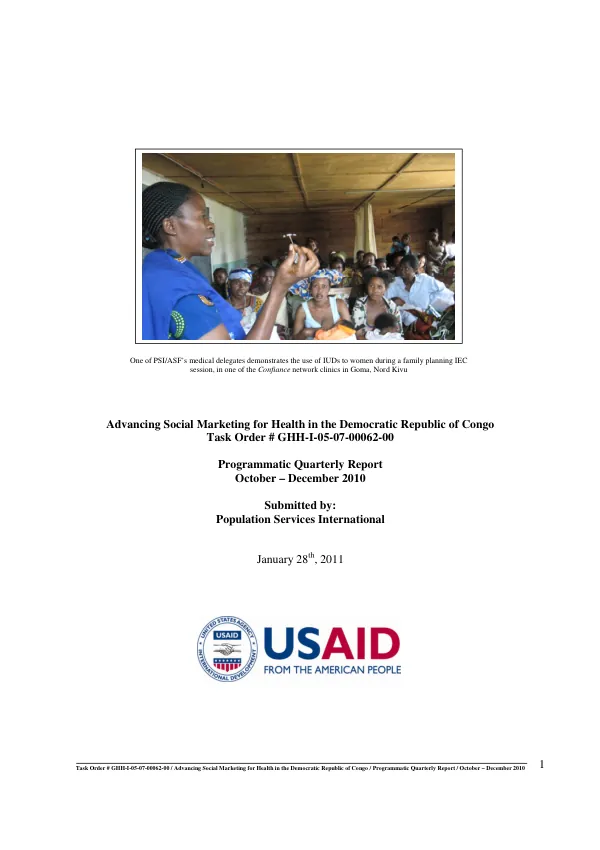
Advancing Social Marketing for Health in the Democratic Republic of Congo: Programmatic Quarterly Report Q1 FY11
Sign inUSAID DEC
Advancing Social Marketing for Health in the Democratic Republic of Congo: Programmatic Quarterly Report Q1 FY11
The programmatic quarterly report for the Advancing Social Marketing for Health in the Democratic Republic of Congo project, funded by USAID, was submitted by Population Services International (PSI)/Association de Santé Familiale (ASF) on January 28, 2011.
2011 · 39 pages
Sign in to readA free account is required to download.
Abstract
The report covers the period from October to December 2010. The program goal is to improve the health status of the people of the Democratic Republic of the Congo by expanding and building upon the achievements of USAID's previous social marketing programs. The program objectives include increasing the supply and diversity of health products and services, increasing awareness and demand for health products and services, developing the ability of commercial/private sector entities to socially market health products and services, and integrating service delivery and other activities. Key successes during the reporting period include the distribution of 4,409,063 male condoms, 186,046 cycles of oral contraceptives, 39,730 injectables, 629 IUDs, and 1,110 Cycle Beads to women of reproductive age. Additionally, 913 Clean Delivery Kits were distributed, and 1,236,186 sachets of PUR and 925,102 tablets of Aquatabs were distributed to treat 30,863,900 liters of water. The program implemented several activities to increase the supply and diversity of health products and services. A national workshop was held in Kinshasa to discuss year 1 project implementation, year 2 objectives and strategies, and data collection tools and procedures. The program also received 2,001,000 Prudence male condoms from USAID and shipped 2,700,000 Prudence male condoms to various provinces. The program also implemented activities to increase awareness and demand for health products and services. A quantitative study was conducted among youth on condom use, which showed a low consumption rate of condoms among this targeted population. The program plans to launch a perfumed and colored male condom to increase attractiveness and consumption. The program also implemented activities to develop the ability of commercial/private sector entities to socially market health products and services. A plan was finalized to extend the network to rural areas through the training of mobile points of sales (cyclists). Additionally, 223 points of sales were created, and their owners benefited from capacity building in stock management, respect of price structure, social marketing, and sensitization of their customers on HIV and its prevention. The program also implemented activities to integrate service delivery and other activities. The FP network was implemented in 14 cities in Kinshasa, Katanga, Bas Congo, Sud Kivu, and Nord Kivu provinces. The program also distributed male condoms by province, with a total of 4,409,063 condoms distributed and 10,533,375 condoms in stock available at the end of December 2010. The program also reported on the distribution of other health products and services, including cycles of oral contraceptives, injectables, IUDs, Cycle Beads, Clean Delivery Kits, PUR sachets, and Aquatabs tablets. The program also reported on the inventory on hand at the end of December 2010 for various health products and services. The program also reported on the challenges faced during the reporting period, including the shortage of Prudence female condoms and the need to conduct a pre-test to identify the preferred perfume and color of condoms. The program also reported on the planned activities for the next quarter, including the pre-test to identify the preferred perfume and color of condoms and the distribution of male condoms by province.