USAID DEC
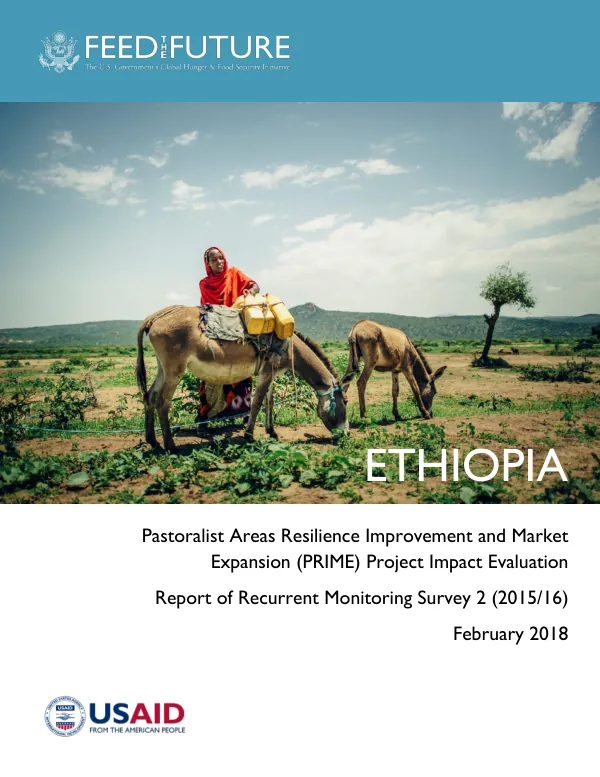
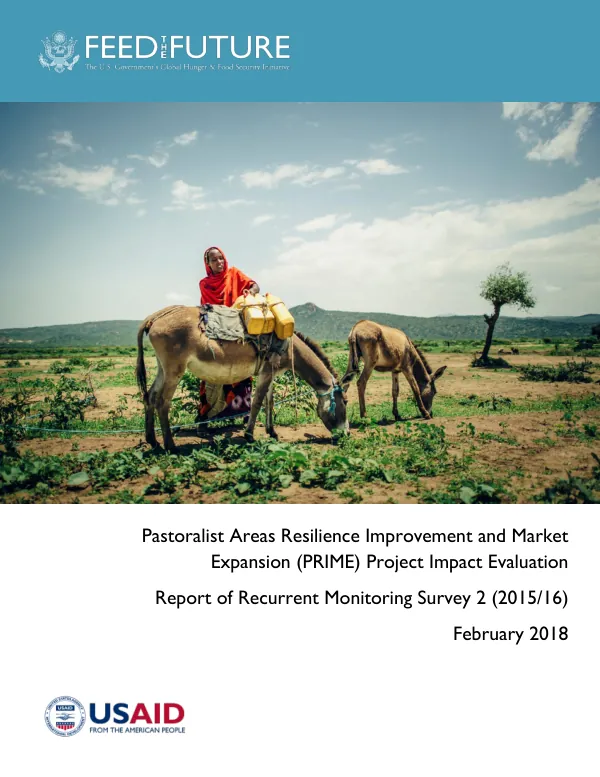
Feed the Future Ethiopia Pastoralist Areas Resilience Improvement and Market Expansion (PRIME) Project Impact Evaluation: Report of Recurrent Monitoring Survey 2 (2015/16)
Sign inMERCY CORPS INTERNATIONAL
Feed the Future Ethiopia Pastoralist Areas Resilience Improvement and Market Expansion (PRIME) Project Impact Evaluation: Report of Recurrent Monitoring Survey 2 (2015/16)
The PRIME Project Impact Evaluation Report of Recurrent Monitoring Survey 2 (2015/16) was conducted in Ethiopia's Borena and Jijiga regions.
2018 · 147 pages
Sign in to readA free account is required to download.
Abstract
The project aimed to improve resilience and market access for pastoralist communities. The evaluation assessed the impact of the PRIME Project on household shock exposure, food security, and resilience. The PRIME Project was implemented in 2015/16, with a focus on improving market access and resilience for pastoralist communities. The project targeted 15,000 households in Borena and Jijiga regions. The evaluation used a mixed-methods approach, combining quantitative and qualitative data collection and analysis. Household shock exposure was a significant concern in the study area, with 70% of households reporting exposure to drought. The drought had a range of downstream impacts, including reduced agricultural production, livestock rearing, and asset ownership. Households that experienced drought shocks also reported higher levels of conflict and death. Children's nutritional status was also affected, with 40% of households reporting a decline in nutritional status. The evaluation found that households that were more resilient to drought shocks were those that had higher levels of asset ownership, better market access, and more diverse livelihoods. Resilience positive deviants were identified as households that had higher levels of resilience despite experiencing drought shocks. Qualitative data suggested that households that were more resilient were those that had better access to information, social networks, and financial resources. Household food security was also assessed, with 60% of households reporting a decline in food security over the RMS-2 period. However, households that were more resilient to drought shocks were also more likely to have improved food security. The evaluation found that households that employed coping strategies such as selling livestock, reducing consumption, and seeking assistance from social networks were more likely to have improved food security. The PRIME Project's impact on household response and coping strategies was also assessed. The evaluation found that households that participated in the project were more likely to employ coping strategies such as selling livestock, reducing consumption, and seeking assistance from social networks. However, the project's impact on household food security and resilience was mixed, with some households experiencing improvements and others experiencing declines. The evaluation's findings suggest that the PRIME Project had a positive impact on household resilience and market access, but its impact on household food security was mixed. The project's success was attributed to its focus on improving market access and resilience for pastoralist communities. However, the evaluation also highlighted the need for further support to improve household food security and resilience in the face of drought shocks.
Related documents
Documents in this collection
 2018
2018USAID DEC
Feed the Future Ethiopia Pastoralist Areas Resilience Improvement and Market Expansion (PRIME) Project Impact Evaluation: Report of Recurrent Monitoring Survey 2 (2015/16)
Open record 2013
2013USAID DEC