GLOBAL COMMUNITIES
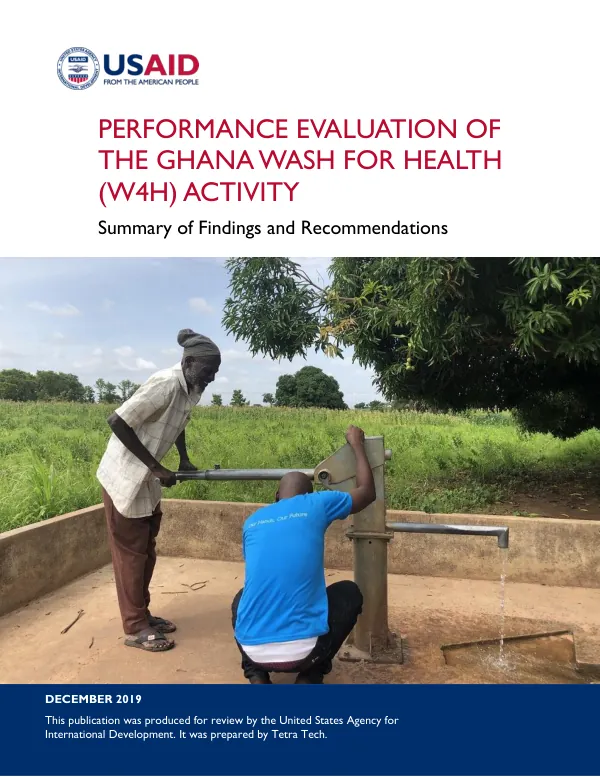
Performance Evaluation of The Ghana WASH for Health (W4H) Activity: Summary
The Water, Sanitation, and Hygiene for Health (W4H) Activity is a five-year cooperative agreement funded by USAID/Ghana and implemented by Global Communities in partnership with The Manoff Group and USAID Global Development Alliance partners Rotary International and The Coca-Cola Africa Foundation.
2019 · 19 pages
Sign in to readA free account is required to download.
Abstract
The goal of W4H is to accelerate sustainable improvement in water and sanitation access and improve hygiene behaviors in 15 target Metropolitan, Municipal, and District Assemblies (MMDAs). By the end of the program, 60,600 Ghanaians are expected to have gained access to improved sanitation and 66,600 to an improved drinking water source. The evaluation aimed to inform the implementing partner and USAID/Ghana on the success of the approaches employed by GC in meeting the activity's goal, identify the need for course corrections or reemphasis of priorities, and assess the approach to and progress of implementation to inform future USAID/Ghana water, sanitation, and hygiene (WASH) programming. The evaluation answered five evaluation questions (EQs) to achieve its objectives. The EQs focused on policy gaps, sustainability of sanitation achievements, private sector engagement, local governance, and handwashing behaviors. The evaluation found that the joint policy developed by USAID and the Government of Ghana (GOG) has served its purpose, but there are existing policy gaps within the WASH sector in Ghana. The evaluation also found that W4H sanitation achievements are likely to be sustained, with a 27% increase in household income among program participants compared to the control group. The evaluation identified successful approaches to private sector engagement for sanitation access expansion, including partnerships with Rotary International and The Coca-Cola Africa Foundation. However, the evaluation also identified gaps in strengthening local governance systems to sustain water services in the country. The evaluation found that W4H has achieved an increase in schools, health centers, and household members practicing basic handwashing behaviors, with a 60% increase in handwashing behaviors among school children. The evaluation recommended short-term and long-term recommendations to address the identified gaps and improve the sustainability of W4H's achievements. The short-term recommendations include revising the W4H policy to address existing policy gaps, strengthening local governance systems to sustain water services, and increasing private sector engagement for sanitation access expansion. The long-term recommendations include developing a comprehensive WASH policy framework, strengthening local governance systems to sustain water services, and increasing private sector engagement for sanitation access expansion. The evaluation team conducted a comprehensive review of the W4H Activity, including a review of project documents, interviews with key informants, and focus group discussions with community members. The evaluation team consisted of experts in WASH programming, policy development, and evaluation methodology. The evaluation was conducted in accordance with the Statement of Work (SOW) and the evaluation methodology outlined in the SOW. The evaluation team would like to acknowledge the invaluable contributions from Clinton Sears for providing guidance in using the Dedoose platform and to Morris Israel and Miriam Otoo for peer reviewing this report. The team would also like to thank the numerous key informants at the national, Metropolitan, Municipal, and District Assembly, and community levels who participated openly and thoughtfully in the interviews and focus group discussions.