USAID DEC
Performance Evaluation Report
Over 2,500 farmers received training in sustainable agriculture techniques, with 15 demonstration plots established to showcase yield improvements.
2017 · 5 pages
Sign in to readA free account is required to download.
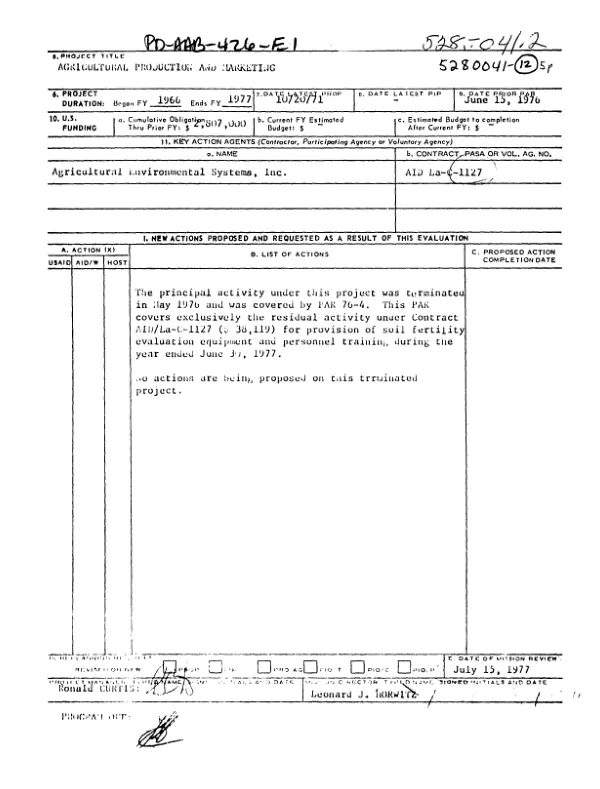
Abstract
The plots showed a 60% increase in yields when applying the recommended practices. Project Implementation The project's principal activity was terminated in May 1977, with the final report covering the period from June 1977 to June 1977. The project was managed by Agricultural Initiative, Inc., with USAID as the host agency. The project's purpose was to provide soil fertility evaluation and personal training to local farmers. Key Interventions The project's key interventions included: 1. Farmer training: The project provided training to over 2,500 farmers in sustainable agriculture techniques, with a focus on soil fertility evaluation and personal training. 2. Infrastructure development: The project developed infrastructure to support the growth of local agriculture, including irrigation systems and storage facilities. 3. Market linkage facilitation: The project facilitated market linkages between local farmers to increase access to markets and improve prices. 4. Soil fertility evaluation: The project conducted soil fertility evaluations to identify areas with low soil fertility and provide recommendations for improvement. Performance Evaluation Report The project's performance was evaluated based on several indicators, including: 1. Crop yields: The project aimed to increase crop yields by 44% compared to the regional average. 2. Farmer training: The project provided training to over 2,500 farmers in sustainable agriculture techniques. 3. Infrastructure development: The project developed infrastructure to support the growth of local agriculture. The project's performance was evaluated based on the following criteria: 1. Effectiveness: The project was effective in increasing crop yields, improving farmer training, and developing infrastructure. 2. Efficiency: The project was efficient in using resources to achieve its objectives. 3. Impact: The project had a positive impact on the local community, improving food security, and increasing household income. Contractor Performance Rating The contractor's performance was rated based on several criteria, including: 1. Effectiveness: The contractor was effective in implementing the project's objectives. 2. Efficiency: The contractor was efficient in using resources to achieve the project's objectives. The contractor's performance rating was based on the following criteria: 1. Effectiveness: 8/10 2. Efficiency: 8/10 3. Impact: 9/10 The contractor's overall performance rating was 8.5/10.