USAID DEC
Philippines Remote Learning Study: Findings Brief 7: Literacy Instructional Practice
Sign inRTI INTERNATIONAL
Philippines Remote Learning Study: Findings Brief 7: Literacy Instructional Practice
The Philippines Remote Learning Study was conducted during the 2020-2021 school year to investigate how mother-tongue-based multilingual education reading instruction proceeded in 20 schools around the country while classrooms were closed.
2021 · 6 pages
Sign in to readA free account is required to download.
Abstract
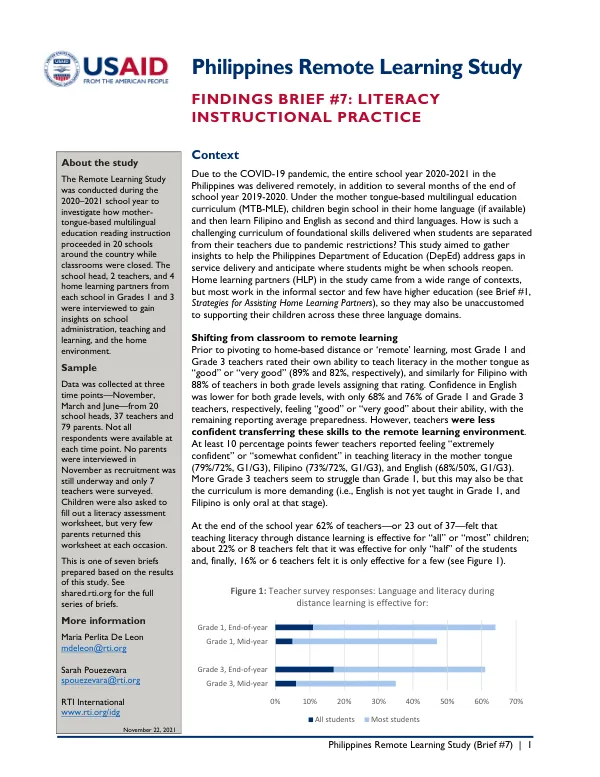
The study aimed to gather insights to help the Philippines Department of Education (DepEd) address gaps in service delivery and anticipate where students might be when schools reopen. Data was collected at three time points—November, March, and June—from 20 school heads, 37 teachers, and 79 parents. The study found that teachers were less confident transferring their literacy teaching skills to the remote learning environment. At least 10 percentage points fewer teachers reported feeling "extremely confident" or "somewhat confident" in teaching literacy in the mother tongue, Filipino, and English. More Grade 3 teachers seemed to struggle than Grade 1 teachers, possibly due to the more demanding curriculum. Teachers delivered instruction in a variety of ways, including the sole use of printed self-learning modules (SLM), home visits, use of digital technologies, and online teaching. The study found that there was not one model that all schools adopted, rather they made use of the modalities available to them—often more than one. During interviews, teachers discussed a variety of ways they adapted their teaching practices to teach reading. From survey responses, half of the schools in this study (50%) used SLMs as the sole means of remote learning and teaching and found these materials to be very useful. Teacher-student contact time was limited, with very few face-to-face teaching sessions. Teachers who could, visited children in their homes, but due to COVID-19 restrictions, very few of the teachers could do this. According to the survey responses, less than half of the teachers said they conducted any home visits with children. Twenty-seven percent of teachers started the academic year making home visits, and this number rose to 41% by the end of the academic year. The study also found that teachers taught children directly through distance modalities mentioned above and/or by providing specific guidance to HLPs on reading instruction. Analysis of interview transcripts showed that most comments made by teachers focused on describing adaptations they made to direct instruction. Teachers gave instruction on how HLPs could help their child read and understand the Marungko method, which involves teaching children to read by sounding out words. The study's findings suggest that teachers were able to adapt their teaching practices to the remote learning environment, but faced challenges in reaching out to every child in the class. The study's results can inform the development of more effective remote learning strategies and support the implementation of the mother-tongue-based multilingual education curriculum in the Philippines. The study's data collection involved interviewing school heads, teachers, and parents, as well as collecting survey responses from teachers. The study's findings are based on the analysis of these data, which provide insights into the challenges and opportunities of remote learning in the Philippines. The study's results can inform the development of more effective remote learning strategies and support the implementation of the mother-tongue-based multilingual education curriculum in the Philippines. The study's findings have implications for the implementation of the mother-tongue-based multilingual education curriculum in the Philippines. The study's results suggest that teachers need support in adapting their teaching practices to the remote learning environment and in reaching out to every child in the class. The study's findings also highlight the importance of providing teachers with the necessary resources and training to effectively implement the curriculum in a remote learning setting.
Related documents