USAID DEC
Pineapple Grading Standards
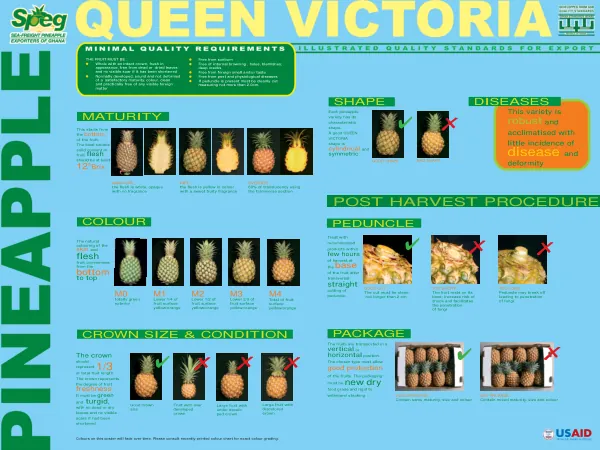
Pineapple quality assessment is a critical factor in determining the fruit's suitability for transportation and sale.
1 pages
Sign in to readA free account is required to download.
Abstract
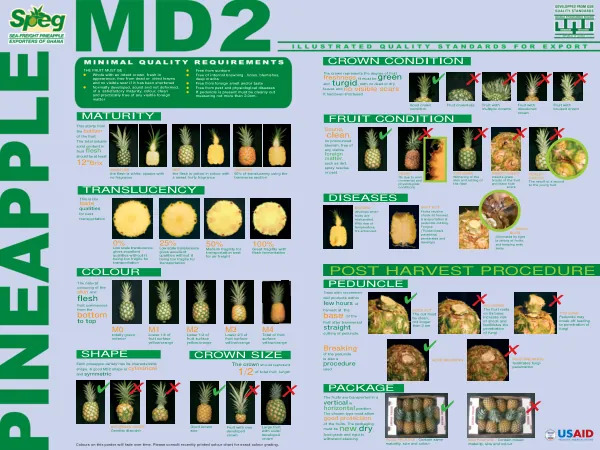
The crown size is a key indicator of fruit freshness, with a well-developed crown representing 1/2 of the total fruit length. A good crown condition is characterized by a green, turgid crown with no dead or dry leaves and no visible scars if the crown has been shortened. Fruit condition is evaluated based on several criteria, including soundness, cleanliness, and freedom from visible foreign matter such as dirt, spray residue, or pest. The crown should be free of any blemishes, bruises, or insect holes. Healed cracks and decay are also assessed, with the latter resulting from environmental and physiological conditions. Bruised fruit develops when fruits are mishandled, and withering of the skin and rotting of the flesh is known as sun burn. Insect holes are caused by insects gnawing the bracts of the fruit, leaving hole scars. Healed cracks result from a wound to the young fruit, while decay is due to environmental and physiological conditions. Soft rot occurs when fruits receive shock at harvest, transportation, and peduncle cutting, allowing fungus (Thielaviopsis paradoxa) to penetrate and develop. Mealy bugs are eliminated by light brushing of fruits and keeping ants away. Good crown condition is essential, and peduncle breaking is a procedure used to assess fruit quality. A good cut is clean and not longer than 2 cm, while a too short cut increases the risk of shock and facilitates the penetration of fungi. A too long cut may cause the peduncle to break off, leading to penetration of fungi. The fruits are transported in a vertical or horizontal position, with the chosen type allowing good protection of the fruits. The packaging must be new, dry, food-grade, and rigid to withstand stacking. A good package contains fruits of the same maturity, size, and colour, while a bad package contains mixed maturity, size, and colour. Good breaking facilitates minimal damage to the fruit, while poor breaking facilitates fungi penetration. The fruit must meet several criteria to be considered of high quality, including being whole with an intact crown, fresh in appearance, free from dead or dried leaves, and no visible scars if it has been shortened. The fruit must also be normally developed, sound, and not deformed, with a satisfactory maturity, colour, cleanliness, and freedom from visible foreign matter. The fruit must be free from sunburn, internal browning, holes, blemishes, deep cracks, foreign smell, and/or taste, as well as pest and physiological diseases. If the peduncle is present, it must be cleanly cut, measuring not more than 2.0 cm. Maturity is assessed based on the flesh's colour and fragrance, with immature fruit having a white, opaque flesh with no fragrance, ripe fruit having a yellow flesh with a sweet fruity fragrance, and overripe fruit having 60% translucency using the transverse section. Colour is evaluated based on the natural colouring of the skin and flesh, which commences from the bottom to top. Each pineapple variety has its characteristic shape, with a good MD2 shape being cylindrical and symmetric.