USAID. MISSION TO DOMINICAN REPUBLIC
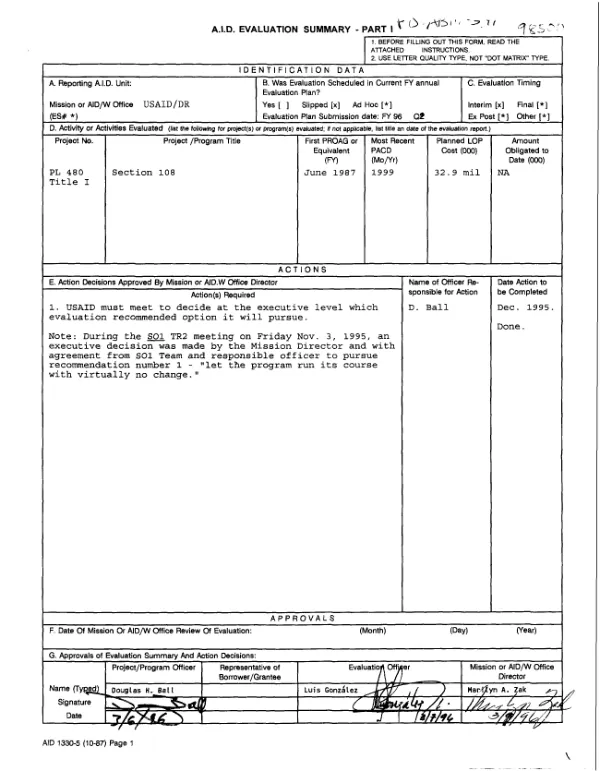
PL-480, Title I, section 108 [program]
Summarizes interim impact evaluation (XD-ABM-541-A) of the P.L.
1996
Sign in to readA free account is required to download.
![PL-480, Title I, section 108 [program]](https://covers.devme.ai/gen/82580.webp)
Abstract
480 Title I Section 108 Program in the Dominican Republic. The evaluation covered the period 6/87-9/95. The program has met its objectives to date. Most of the loans provided have gone to agricultural private enterprises and many have promoted consumption of U.S. agricultural commodities. Banks have generally lent to low-risk sub-borrowers and the default rate has been extremely low. In addition, the program has provided a maximum of safety and security to Section 108 funds. The program"s efficiency improved greatly during 1994. As of 3/31/95, the funds utilization ratio was 94%, and there is little indication that the rate has fallen substantially during the past 6 months. Payments received by USAID under the program have been timely and complete. Subloans are concentrated (87%) in the production of agriculture-related goods and services, with over 30% going to producers who utilize U.S. inputs such as livestock feed, caustic soap, and tallow. Interest rates are, on average, 1-2 points below the prime rate. They are, in short, attractive but still market rates. However, a full 60% of subloans have been for working capital as opposed to 10% for capital investment, and banks have tended to allocate funds to safe investments with large firms in protected sectors such as rice and poultry as opposed to nontraditional economic activity. These outcomes, while not opposed to the original terms of the program, which focused almost entirely on promoting productive, private enterprise investment, do not meet the Mission"s current objectives, which focus on increasing access to economic opportunities and benefits for the majority of Dominicans. As currently implemented, the Section 108 program does not fit well within this strategic framework. The following lessons were learned. (1) All other things being equal, commercial banks will sublend to safe, low-risk sub-borrowers, which generally means relatively well-off sub-borrowers. If USAID wants to have a higher percentage of poor among sub-borrowers, more restrictive conditions must be imposed. (2) Since the program sublends relatively heavily to protected sectors, it is tempting to impose conditions restricting sublending to those sectors. Doing so would attack a symptom, however, not a cause. Although protectionism is a major problem in the Dominican Republic, it is beyond the purview of this program to correct it. (3) Anecdotal evidence suggests strongly that the program has had a greater impact on small and remote sub-borrowers, in contrast to larger sub-borrowers, for whom the loan was just one of many sources of capital. (4) The concerns guiding a Mission"s program in one era may differ from those in another. An evaluation may thus come to the anomalous conclusion that a program is both successful and out of sync with current Mission objectives. The advisability of modifying the program will be a function of the transaction costs involved. If they are too high, it may be preferable to leave things alone. (5) If a program is designed to be largely self-managed, there is little incentive for the Mission to see it as part and parcel of its development program and to monitor and evaluate it conscientiously. (6) The Section 108 program committees both in Washington and in the field focused almost exclusively on getting the program off the ground. When the program was not renewed by Congress, the committees disbanded, leaving no governing body to consider mid-course corrections to programs already underway.
Related documents