USAID. MISSION TO SRI LANKA
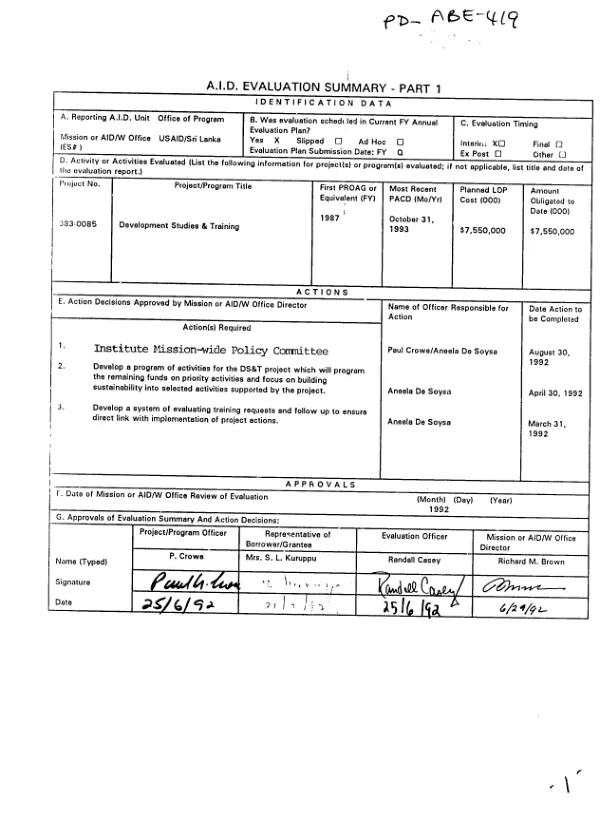
Development studies and training
Summarizes interim external evaluation of a project to strengthen the policy analysis and reform capacity of the Government of Sri Lanka (GSL) by financing training for government officials, policy studies, and TA.
1992
Sign in to readA free account is required to download.
Abstract
The evaluation covered the period 8/87-11/91. Under the participant training component, 104 persons have been trained; of these, 3 have received long-term academic training, 7 were sent on invitational travel, and the remainder have participated in short-term programs. The project"s studies/TA component has funded 26 major policy studies, and 10 TA assignments. However, the latter component was so loosely structured, so flexible in responding to perceived targets of opportunity, that it has been difficult to implement and to evaluate. The Project Paper guidelines, which emphasized that the policy studies must have a clear objective of policy articulation and implementation, were violated several times. Not all of the studies are likely to lead to implementation because the process of choosing the studies was poorly structured, as was follow-up dialogue with the GSL on study findings. Moreover, the quality of the studies has been mixed, and the quantity too great, leaving only a small amount of funding for the balance of the project. Implementation is most likely to occur in cases where a study was selected in response to a felt need articulated by a group within the GSL and performed in close collaboration with that group. While the evaluation included several recommendations for a follow-on policy project, the Mission has decided not to fund a follow-on project, but to develop a mechanism -- a Policy Committee -- through which the policy dialogue process can be managed in the Mission. With this in mind, the Mission notes the following lessons. (1) Policy dialogue is a multilateral bargaining process within which clarity, timeliness, and packaging are all important. The roles of political leadership and influential interest groups are critically important. (2) It is a country"s mix of policies, through all its ministries, that is important in establishing policy credibility and enabling an effective and dynamic market economy.
Related documents
![Shared control of resources [SCOR] under natural resources and environmental policy project](https://covers.devme.ai/gen/16711.webp)