USAID DEC
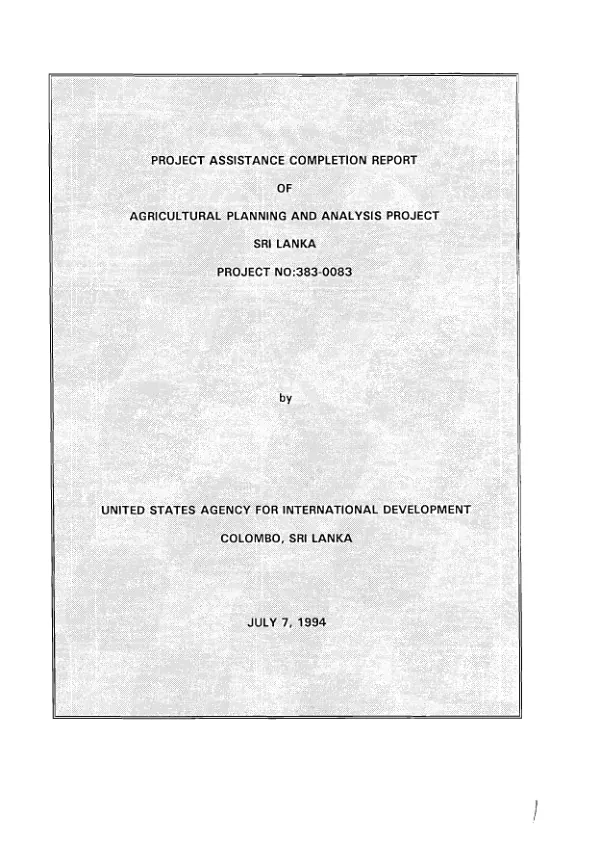
Project assistance completion report of agricultural planning and analysis project, Sri Lanka -- project no. 383-0083
Sign inUSAID. MISSION TO SRI LANKA
Project assistance completion report of agricultural planning and analysis project, Sri Lanka -- project no. 383-0083
PACR of a project (8/86-12/93) to develop an integrated, national-level agricultural policy analysis and planning system in Sri Lanka.
1994
Sign in to readA free account is required to download.
Abstract
The project was implemented by the Ministry of Agricultural Development and Research with TA from Abt Associates through a host country contract. The project's greatest asset was timing; as it progressed, the policy environment in Sri Lanka brightened and the Government of Sri Lanka (GSL) accelerated the pace of reform in the early 1990's, enabling the project to take a more active role in economic reform than had been planned. The long-term advisor was able to present sound, prioritized policy alternatives on short notice to GSL decisionmakers. Training and commodity procurement supported the project's institution-building and policy analysis objectives, although the procurement component experienced delays related to A.I.D. regulations. The project supported long-term, academic training for 37 M.Sc.s or Ph.D.s, over 75 short-term and diploma courses, and numerous study tours; this part of the project was felt by many to be the most important, although A.I.D. requirements for English-language testing slowed implementation. The project funded extensive computer installation and training, which improved the manner in which GSL policy and planning units operate. The main project output changed from production of a National Agricultural Growth and Restructuring Strategy to the formulation of Provincial Agricultural Development Strategies. This may appear to have narrowed the scope, but in reality made all the difference between a document to be shelved and a document to be carried to full implementation, because the Provincial Strategies have been incorporated into the GSL's annual Public Investment Program, whereas implementation of a national strategy would depend on the resolution of political issues. Chances for sustainability appear to be strong: planning units are functioning as integral parts of each participating ministry, the GSL budget supports these units, project-funded commodities are being used appropriately, and, perhaps, most importantly, a network of well-trained and motivated technical officers and policy analysts are situated in key ministries. In addition, eight provincial development strategies are complete, and background analysis is complete for a national strategy to be finalized in early 1995. Twenty major policy and institutional reforms have been implemented with project support and several more are still underway or under consideration. The following lessons were learned. (1) Projects to develop planning systems must include all agencies involved in the system. All these agencies must be given enough support to attract them to the system, but they do not all need to be given equal amounts of support. (2) Policy analysis with on the job training in mind means a slower pace, as most of the responsibility is placed on the planning staff of the participating agencies. A compromise on technical rigor has to be accepted with the understanding that this is a small price to pay for ensuring sustainability of the analytic effort. (3) TA is a highly personalized activity and is most effective when providers are competent within their discipline and have country experience and cultural sensitivity. (4) Host country contracts create administrative headaches and are no longer encouraged by the Agency, but they can provide the basis for relationships that are programmatically effective. (5) Agricultural and rural sector projects should be considered within the context of the broad political economy, not in economic isolation. (6) Policy reforms will take place when governments perceive them as being in their own interests; donors must be prepared, administratively and conceptually, to respond quickly. (7) It is usually impossible to pinpoint the genesis of policy change and assign credit to any one donor. (8) Despite its management-intensive nature, training is an important investment in long-term, sustainable policy and development change, and one that the United States does well. Because of the increasing complexity of A.I.D. and USG regulations, project modifications, training, and commodity procurement are becoming more and more difficult to implement. At the time of PACR preparation, the Mission was still considering how to best structure and fund a policy analysis activity to build on the success of this project. A lessons learned report by the long-term Abt Associates advisor is appended.
Related documents