USAID
Plan Operativo Anual y Presupuesto del MAGA alineados al Plan del Pacto Hambre Cero
The agricultural development initiative in Guatemala is aligned with the Zero Hunger Pact, a national commitment to reduce hunger and malnutrition.
2015 · 1 pages
Sign in to readA free account is required to download.
Abstract
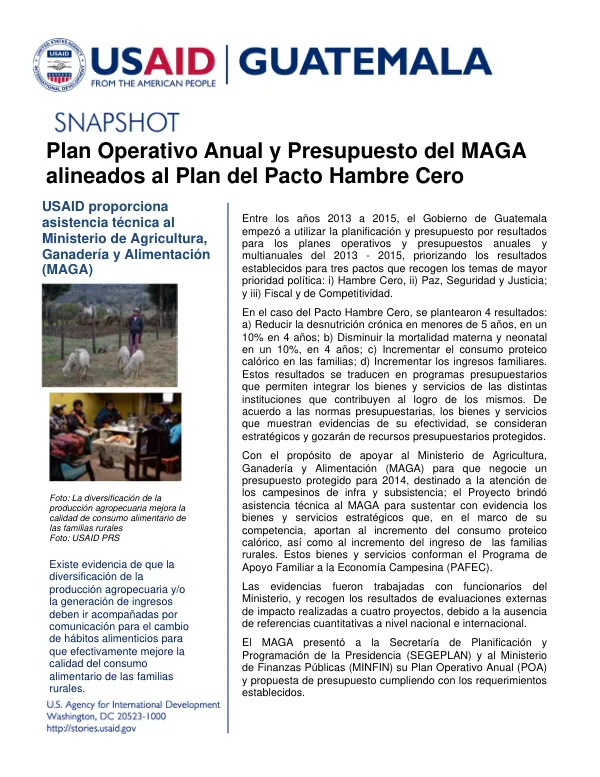
The Ministry of Agriculture, Livestock, and Food (MAGA) is the primary institution responsible for implementing the pact's objectives. USAID provides technical assistance to MAGA to support the development of a protected budget for 2014, focusing on the needs of small-scale farmers and rural households. The Zero Hunger Pact established four key outcomes: reducing chronic malnutrition in children under five years old by 10% in four years, decreasing maternal and neonatal mortality by 10% in four years, increasing protein-caloric consumption in families, and increasing household income. These outcomes are translated into programmatic budgets that integrate the resources and services of various institutions contributing to their achievement. According to Guatemala's budgetary norms, goods and services demonstrating effectiveness are considered strategic and will receive protected budgetary resources. To support MAGA in negotiating a protected budget for 2014, USAID provided technical assistance to the ministry to substantiate evidence-based strategic goods and services that contribute to increasing protein-caloric consumption and household income in rural areas. These goods and services form the Program of Family Support to the Rural Economy (PAFEC). The evidence was worked on with MAGA officials and is based on the results of external impact evaluations conducted on four projects, due to the absence of quantitative references at the national and international levels. The MAGA presented its Annual Operational Plan (POA) and budget proposal to the Secretariat of Planning and Programming of the Presidency (SEGEPLAN) and the Ministry of Public Finance (MINFIN), meeting the established requirements. The POA and budget proposal focus on the needs of small-scale farmers and rural households, with a particular emphasis on increasing protein-caloric consumption and household income. The initiative aims to support the development of a protected budget for 2014, which will enable MAGA to address the needs of rural households and contribute to the achievement of the Zero Hunger Pact's objectives. The initiative's geographic focus is on rural areas, where small-scale farmers and rural households are the primary target population. The timeframes for the initiative are 2014 and beyond, with a focus on achieving the outcomes established in the Zero Hunger Pact. The recommendations for the initiative include the continued provision of technical assistance to MAGA to support the development of a protected budget and the implementation of the PAFEC program.
Related documents